
Somewhere above your head, right now, human beings are living in space.
They have been doing so every single day since November 2, 2000 — twenty-five years of unbroken human presence in low Earth orbit, through wars and pandemics and political upheavals, through fourteen different US presidents and dozens of heads of government around the world. Through all of it, the International Space Station has kept its lights on, its systems running, and its crew alive.
But the countdown has begun.
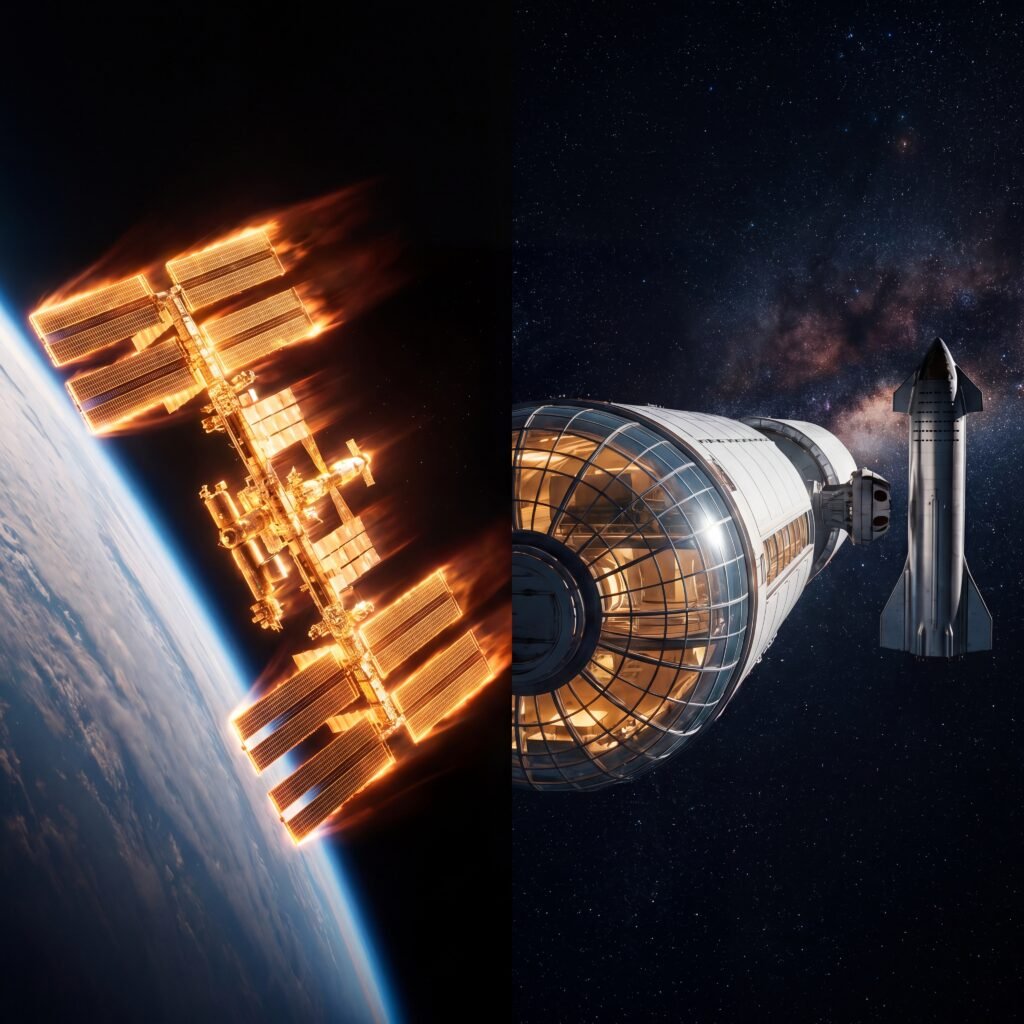
The International Space Station will be deorbited in 2030, marking the end of its three-decade mission and an era of peaceful international cooperation — and a shift toward commercial space stations.
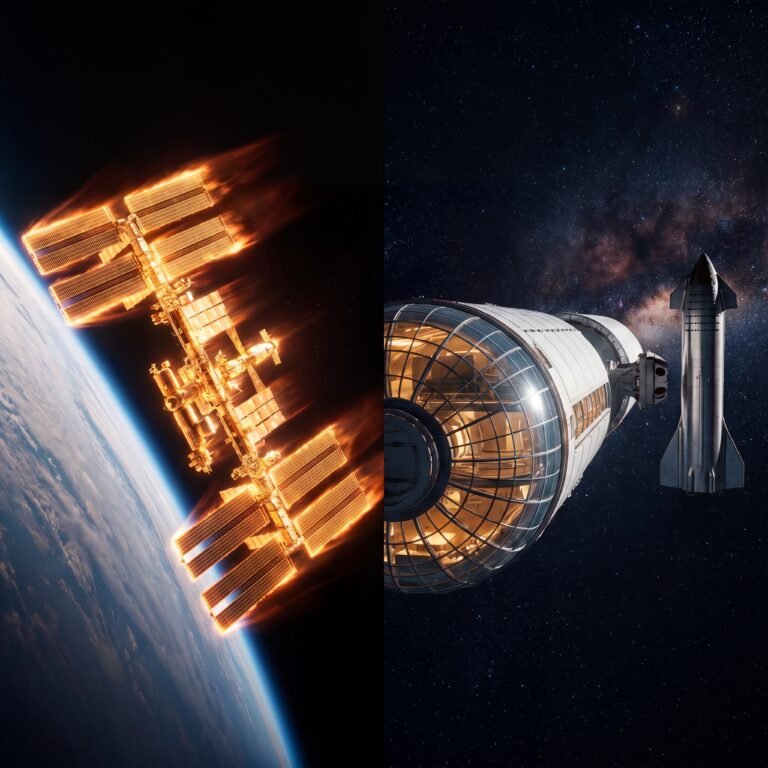
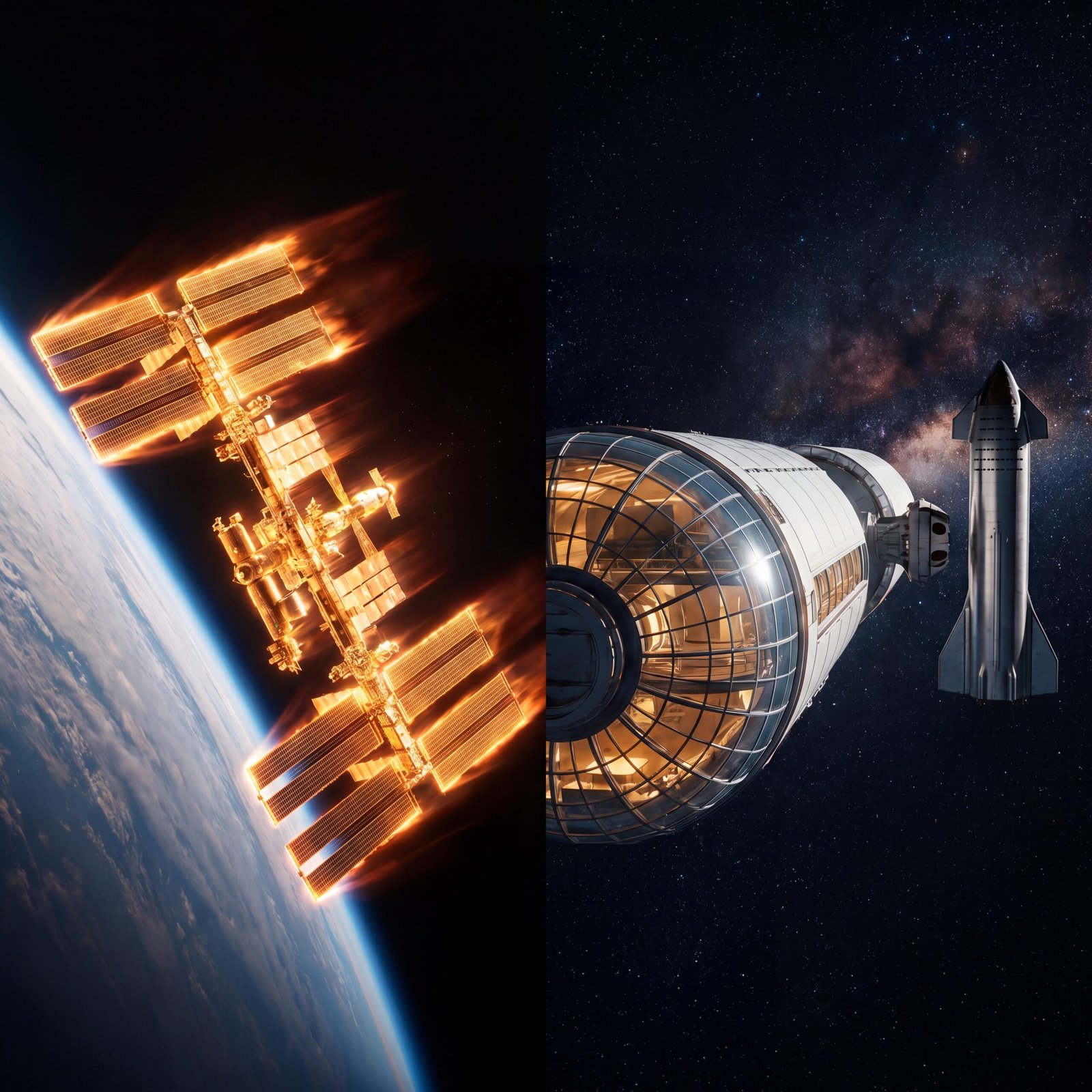
When the ISS falls, it will fall deliberately. It will fall in a blaze of fire over the most remote stretch of ocean on Earth. And what rises in its place will be something humanity has never seen before — not a government outpost, not a symbol of superpower rivalry, but a commercial space economy operated by private companies, open to paying customers, designed not just for astronauts but for entrepreneurs, researchers, tourists, and manufacturers.
The age of the space station is not ending. It is just beginning.
Here is the full story of the ISS — where it came from, where it is going, and what extraordinary future is being built to replace it.
The Greatest Machine Ever Built
Before we talk about the end, we need to understand what is being lost.
The International Space Station is, by almost any measure, the most complex and ambitious engineering project in human history. It is roughly the size of a football field, weighing approximately 420,000 kilograms — nearly half a million pounds. It orbits Earth at 17,500 miles per hour, completing one full orbit every 90 minutes. Every 90 minutes, the crew on board experiences a sunrise and a sunset.
Over 4,000 experiments have been conducted aboard the ISS, generating more than 4,400 research publications that advanced understanding of materials science, biotechnology, and medicine. Breakthrough discoveries include advances in thunderstorm understanding, improvements in cancer-fighting drug crystallization processes, artificial retina development, ultrapure optical fiber processing, and DNA sequencing capabilities in microgravity environments.
The station has hosted astronauts from 19 countries, conducted spacewalks totaling over 1,000 hours, and supported critical research enabling future deep space exploration missions to the Moon and Mars.
It has also served as a symbol — perhaps the most powerful symbol of international cooperation that the modern world has ever produced. At the height of the Cold War, the United States and the Soviet Union pointed nuclear weapons at each other. Thirty years later, American astronauts and Russian cosmonauts were sharing a toilet in orbit and troubleshooting each other’s life support systems together.
Since November 2000, there have always been several humans on board the football field-sized scientific laboratory, whipping around the planet at eight kilometres per second.
That streak — 25 years and counting — will end in 2030.
Why Is the ISS Being Retired?
The ISS was never designed to last forever. Its original operational lifespan was 15 years. Engineers, astronauts, and managers have pushed it to more than 30. But time and the brutal environment of space are unforgiving.
It is no longer possible to extend operations indefinitely because of the station’s complicated modular design and the wear and tear it has sustained over decades in space. The station’s original lifespan of 15 years has been extended by many years, but its primary structural components, life support systems, and electronics are getting old, making it expensive and risky to continue habitation.
Cosmic radiation has charred the glass on the solar cells powering the ISS, while repeated docking and undocking have led to its gradual structural degradation.
The cracks — literally — are beginning to show. Russian modules have developed air leaks. Aging systems require constant, expensive maintenance. And every year that passes, the risk of a serious failure grows higher.
The economics tell the same story. The ISS costs approximately $3 to $4 billion per year to operate — a figure that NASA, under pressure from Congress and the White House, increasingly cannot justify when the same money could be funding Moon and Mars programs.
The verdict is final: the ISS must go.
How the ISS Will Die — The Most Spectacular Ending in History
The ISS will not simply be abandoned to slowly decay and fall unpredictably. That would be dangerous — 420,000 kilograms of metal raining down on populated areas is not acceptable. Instead, NASA has planned one of the most precisely engineered events in history: a controlled, deliberate deorbit.
SpaceX was awarded a $843 million contract in June 2024 to develop the U.S. Deorbit Vehicle (USDV), a modified Dragon spacecraft that will guide the 420-ton station to a controlled reentry over the uninhabited South Pacific Ocean.
The ISS will gradually descend as natural atmospheric drag slowly lowers its orbit. Once the last crew has returned to Earth, the U.S. Deorbit Vehicle will approach the ISS, dock with it, and act as a space tug — aiming the station toward Point Nemo, the most remote location on Earth’s surface.
Point Nemo. The name itself sounds like science fiction. It is real — a point in the South Pacific Ocean so far from any land that the nearest human beings are often the astronauts on the ISS passing overhead. It is known as the spacecraft cemetery, and it is where humanity sends its largest machines to die.
Around 300 vehicles already rest at Point Nemo, and their number continues to grow. In 2030, the International Space Station, weighing over 400 tons, will also be sent there — making it the largest human-made object ever brought down through Earth’s atmosphere.
At around 460 tons and the size of a football field, it will become the largest human-made object ever brought down through Earth’s atmosphere. The ISS will break all records — even in death.
Most of the station will burn up during reentry, generating a spectacular streak of light across the sky visible for thousands of miles. Some heavier components will survive the heat and splash into the Pacific. And then, silence.
Thirty years of continuous human presence in space, ended in fire and ocean.
The Commercial Revolution: What Comes Next
But here is what makes this story extraordinary. The end of the ISS is not the end of humans living in space. It is the beginning of something far more ambitious — and far more democratic.
NASA’s director of the ISS and Commercial Spaceflight Division put it plainly: “We’re preparing to transition to commercially owned and operated space stations.” She added: “I’m excited about the new platforms and all that they will have to offer, and I’m excited about continuing our work in low-Earth orbit.”
The idea is this: rather than the US government spending billions to build and operate its own space station, NASA will instead purchase services from private companies that build and operate their own stations. NASA becomes a customer — one of many. The government gets the research access it needs, commercial operators get a guaranteed anchor tenant, and the door opens to an entirely new class of space user: private companies, tourists, researchers, filmmakers, manufacturers, and more.
NASA announced commercial space station development awards to Blue Origin’s Orbital Reef, Axiom Space’s Axiom Station, and Starlab Space — and has awarded over $400 million to develop commercial space stations, with Phase 2 partnerships announced in September 2025 to ensure a seamless transition before ISS retirement.
This is the commercial space revolution. And the race to lead it is already underway.
Meet the Contenders: The Space Stations of Tomorrow
Vast Space — Haven-1: The First Challenger
Vast is targeting a Q1 2027 launch for its Haven-1 station aboard a SpaceX Falcon 9. If successful, it would be the first standalone commercial space station in orbit.
Haven-1 is compact by ISS standards — roughly the size of a large shipping container — but it is designed with a philosophy the ISS never prioritized: comfort and experience.
The company has tried its best to make the facility more comfortable than the utilitarian ISS, with “earth tones,” soft surfaces, inflatable sleep systems, and a revamped menu. The single-module station will host crews of four for up to 10 days.
Alongside Haven-1, NASA has awarded Vast a Private Astronaut Mission launching in 2027 — training, launching, and returning a four-person crew to and from the International Space Station ahead of Haven-1’s own operations.
Haven-1 is a stepping stone to Haven-2, which is designed to succeed the ISS. Vast plans to launch the first Haven-2 module in 2028, then add new modules every six months for a total of four by 2030. At that size, the space station will be able to support crews of up to eight astronauts.
Axiom Space — Axiom Station: The Boutique Hotel in Orbit
Axiom Space is taking a uniquely clever approach. Rather than building a station from scratch and launching it independently, Axiom Space is initially attaching its first module to the ISS itself, then later separating and joining with a second Habitat module to form a free-flying station as early as 2028.
Axiom Station is designed to look like a boutique hotel and is expected to be operational by 2028.
Think about that phrase: a boutique hotel in orbit. Axiom has hired legendary interior designer Philippe Starck to design the interior of its modules — soft curves, warm lighting, panoramic windows overlooking Earth, and a sensory experience deliberately designed to make guests feel they are in an extraordinary place, not a utilitarian research outpost.
Axiom Space has raised $350 million in recent funding to accelerate its station development. It has already flown four private astronaut missions to the ISS, gaining operational experience that no competitor can match.
Starlab: The Space University
Starlab Space — a joint venture between Voyager Space and Airbus, with Mitsubishi Corporation and MDA Space also involved — is targeting a 2029 launch.
Starlab is designed around a vision of the space station as a scientific institution — a university-level research environment in orbit, with facilities for biology, materials science, medicine, and advanced manufacturing. It will launch its entire station in a single vehicle rather than assembling it module by module, a bold engineering choice that, if it works, will dramatically simplify the deployment process.
Blue Origin’s Orbital Reef: The Space Business Park
Blue Origin, founded by Jeff Bezos, is working with Sierra Space and Boeing to build Orbital Reef, which they describe as a “mixed-use business park 250 miles above Earth.”
Blue Origin’s Orbital Reef space station plans to launch in 2030. In its initial configuration, Orbital Reef will consist of five modules, supporting up to 10 crew members and offering research, manufacturing, and commercial activities under one roof — or rather, one hull.
The business park analogy is deliberate. Orbital Reef is designed to be a place where multiple different companies can lease space — a research lab here, a manufacturing bay there, a tourism module somewhere else — all sharing the same life support infrastructure while pursuing completely independent business objectives.
Who Will Go to These New Stations — And What Will They Do?
The ISS was designed for professional astronauts doing government-funded science. The new commercial stations are designed for everyone else too.
Paying customers will be able to experience life in microgravity and conduct research such as growing plants and testing drugs. The cost of a stay aboard any of these outposts has not been released, but expect ticket prices in the tens of millions of dollars at first.
But beyond space tourism, the commercial station era opens an entirely new frontier: microgravity manufacturing.
In the microgravity environment of space, materials behave in ways that are impossible to replicate on Earth. Protein crystals grow larger and more perfectly formed — potentially enabling drug discoveries that could treat diseases including Parkinson’s, Alzheimer’s, and cancer. Optical fibres produced in space can achieve a purity that no Earth-based facility can match. Semiconductor materials form without the defects caused by gravity. Biological tissues can be grown in three dimensions without scaffolding.
For decades, these possibilities have been demonstrated on the ISS but never commercialized at scale. The commercial space stations of the 2030s are designed to unlock this potential — turning low Earth orbit into an industrial zone as well as a scientific one.
The Risk: What If No One Is Ready?
The transition from the ISS to commercial stations is not without risk. And in 2026, that risk is very real.
With no clear alternative in sight, US lawmakers are concerned about whether private companies will be prepared to replace the ISS by 2030. The ISS has served as a home to astronauts in low-Earth orbit for 26 years, but the aging spacecraft is nearing the end of its life.
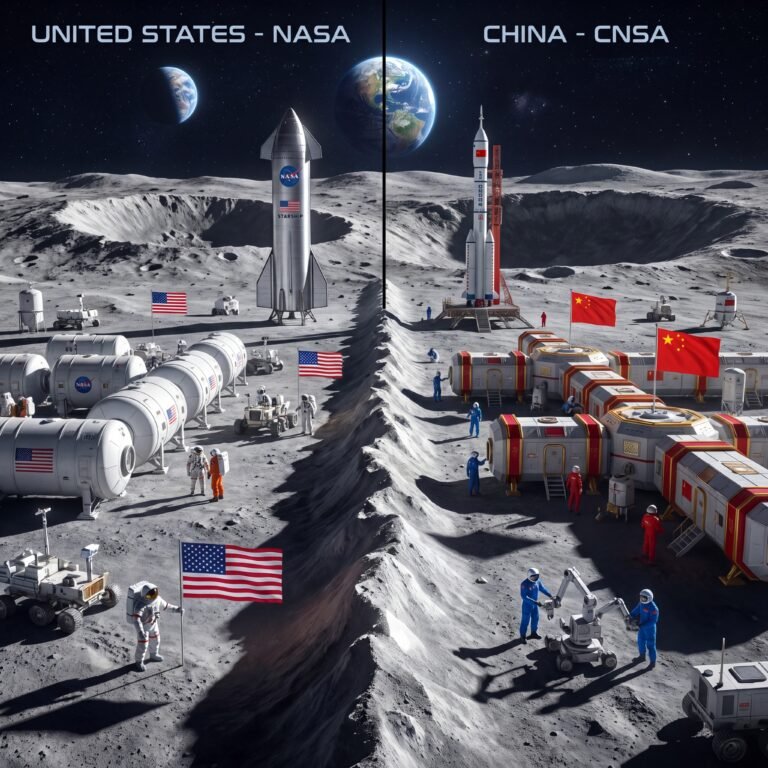
Without a US replacement ready in time, China’s Tiangong space station could soon become the world’s only permanently inhabited orbital outpost — a symbolic and strategic shift that has added urgency to NASA’s efforts to foster a new generation of commercial space stations.
After 2030, the only space station orbiting Earth will be China’s Tiangong — unless commercial stations are ready. China’s Tiangong is set to be the only government-run station in orbit.
The gap between the ISS retiring and commercial stations becoming fully operational is the central anxiety of the current moment. If Vast’s Haven-1 launches in early 2027 as planned, there will be a continuous — if brief — commercial presence in orbit to bridge the gap. If it slips further, the period between the ISS’s retirement and a functioning commercial replacement could see no American presence in low Earth orbit at all.
That is a scenario both NASA and Congress are determined to prevent.
The Emotional Weight of the End
There is something profound about the impending loss of the ISS that goes beyond strategy and economics.
For a generation of people alive today, the ISS has always been there. Every clear night, you can sometimes see it passing overhead — a bright, steadily moving star that is actually 420,000 kilograms of metal and glass and human ingenuity, moving at five miles per second, carrying human beings who are at this very moment conducting experiments and eating rehydrated food and watching sunrises every ninety minutes.
Robyn Gatens, director of the ISS, said: “I’ve worked on the International Space Station my whole career so, yes, it is bittersweet to think about one day deorbiting it — all that it has stood for and all the work and science that has been conducted there.”
The ISS was built by 16 nations at the height of the post-Cold War optimism of the 1990s, when the idea that humanity could transcend its divisions and cooperate on something truly magnificent seemed not just possible but inevitable. Whatever its flaws, it delivered on that promise. American astronauts and Russian cosmonauts lived together, worked together, and trusted each other with their lives for decades.
The new commercial era will be different. More entrepreneurial, more diverse in purpose, and ultimately more accessible. But it will lack the symbolic weight of what came before — the fragile, remarkable, extraordinary machine that has been humanity’s home in space for 25 unbroken years.
The Bottom Line
The International Space Station is ending. By late 2030, it will burn through Earth’s atmosphere in a blaze visible across the Pacific sky, and its remains will settle into the spacecraft cemetery at Point Nemo — joining the hundreds of machines humanity has sent before it.
But something remarkable is rising to take its place. Not one station — several. Not government-owned — commercial. Not closed to ordinary people — open to researchers, entrepreneurs, manufacturers, and eventually tourists from around the world.
Jeff Bezos has long posited that millions of people will one day live and work in space. NASA and SpaceX CEO Elon Musk have been vocal about humans living on the Moon and Mars. The commercial stations of the 2030s could be the precursor to all of it.
The ISS was humanity’s first home in space. The stations that replace it may be the first step toward a future where space is simply where some people live — as naturally and routinely as living in a city, on a coast, or on a mountain.
The ISS is dying. Long live the new age of space.
🌐 Follow neboda.ai — your daily guide to the future of space exploration, commercial spaceflight, and humanity’s next great chapter beyond Earth.