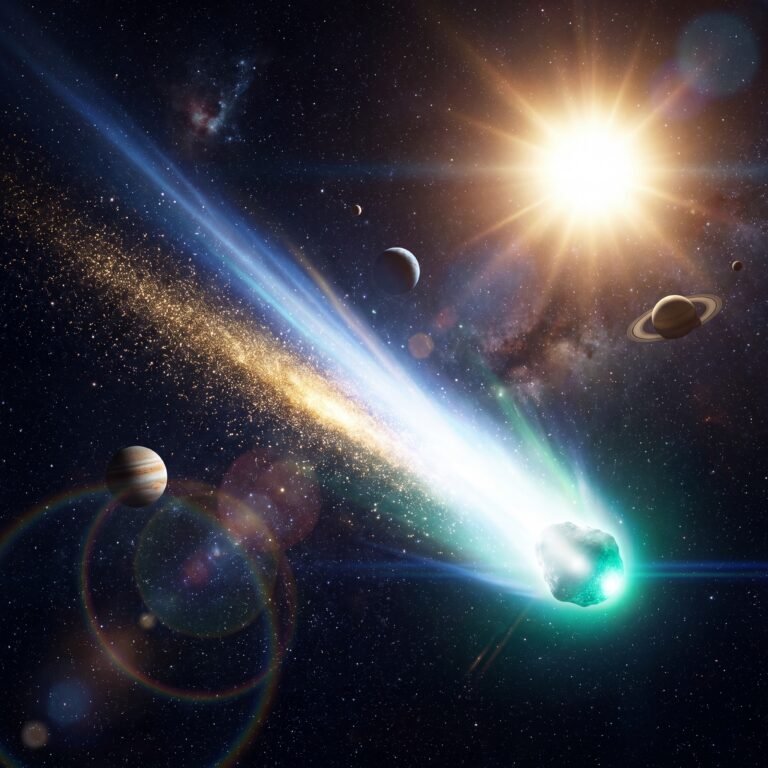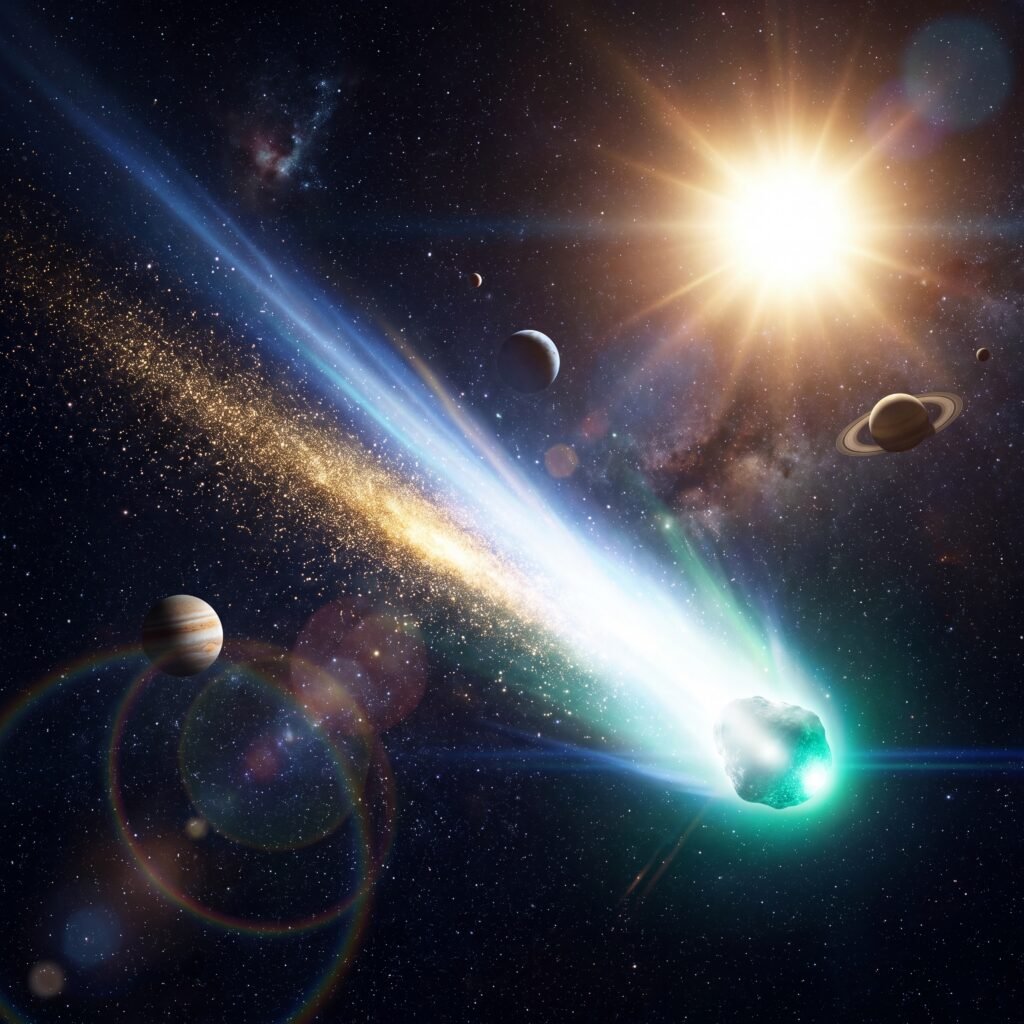

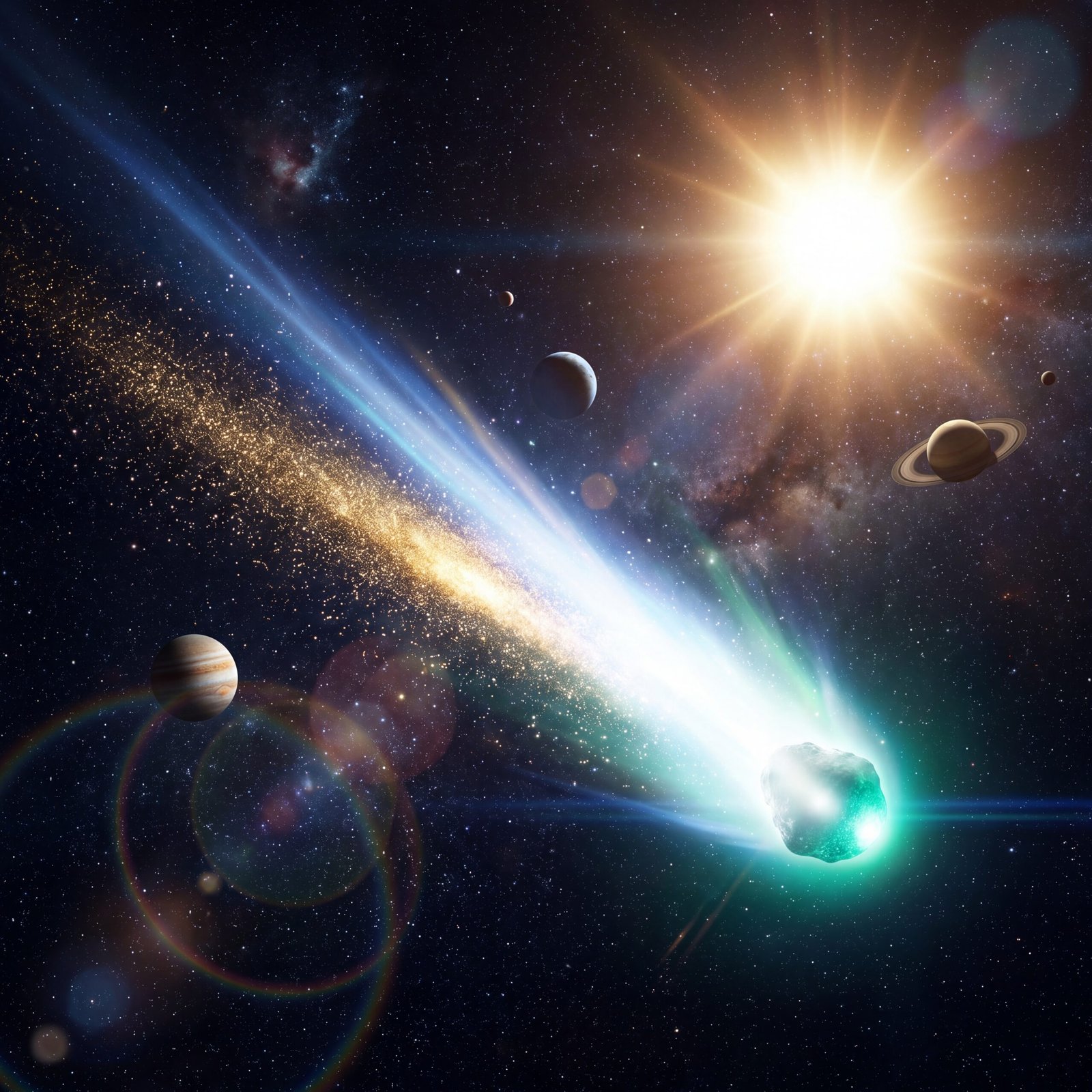
Somewhere in the vast darkness between the stars, a frozen traveler had been drifting for almost as long as the universe itself has existed.
It formed before our Sun was born. Before Earth existed. Before the dinosaurs, before the first single-celled organisms, before the oceans of our young planet had even condensed from vapor — this ancient wanderer was already hurtling silently through the galaxy, carrying locked within its frozen heart a chemical record of a world we will never visit, orbiting a star that may no longer even exist.
In July 2025, it arrived.
It swept through our solar system at over 137,000 miles per hour, looped around our Sun, and began its long journey back out into the interstellar void — a journey from which it will never return.
Its name is 3I/ATLAS. And it is one of the most extraordinary objects ever to pass through our cosmic neighborhood.
What Is 3I/ATLAS?
Comet 3I/ATLAS is only the third known object to pass through our solar system from outside it. That fact alone deserves a moment of reflection. In all of recorded human history — with all of our telescopes, all of our sky surveys, all of our astronomical observations stretching back thousands of years — we have only ever confirmed three visitors from beyond our solar system.
The first was ‘Oumuamua, discovered in 2017 — a strange, elongated, reddish object that puzzled scientists because it appeared to accelerate in ways that couldn’t be fully explained by gravity alone. Some researchers, including a Harvard astrophysicist, controversially suggested it might be an alien artifact.
The second was comet 2I/Borisov in 2019 — a more conventional-looking comet that gave scientists their first clear look at an interstellar icy body.
And the third is 3I/ATLAS. The most scientifically rich interstellar visitor we have ever encountered.
Comet 3I/ATLAS was discovered by the NASA-funded ATLAS survey telescope in Rio Hurtado, Chile, and reported to the Minor Planet Center on July 1, 2025. The comet is named 3I/ATLAS because it is the third (3) interstellar (I) object found passing through our solar system, discovered by the ATLAS telescope.
And from the very first moment it was identified, scientists knew something was deeply unusual about this visitor.
The Speed That Gave Everything Away
The first clue that 3I/ATLAS came from outside our solar system was its speed — and the way it moved.
When it was discovered, 3I/ATLAS was traveling at about 137,000 miles per hour. Pulled by the Sun’s gravity, its speed increased to about 153,000 miles per hour at its closest approach to the Sun — known as perihelion.
For context: the fastest human-made spacecraft ever launched, NASA’s Parker Solar Probe, reaches speeds of around 430,000 miles per hour at its closest approach to the Sun. But 3I/ATLAS achieved its blistering 153,000 mph speed without any rocket engines, simply from the momentum it carried from interstellar space — momentum accumulated over billions of years of travel between the stars.
No object born in our solar system moves this fast. Objects in our solar system are gravitationally bound to our Sun — they follow closed, elliptical orbits. Its extraordinary speed and strange trajectory indicated that it must have been traveling through interstellar space for possibly billions of years.
As astronomer David Jewitt put it with brutal simplicity: “It’s like glimpsing a rifle bullet for a thousandth of a second.”
It’s Ancient Beyond Comprehension
Here is where the story gets truly staggering.
Its estimated age of up to 12 billion years makes it potentially the oldest interstellar visitor ever detected — likely born in the early galaxy, long before our Sun ignited.
Our solar system — including the Sun, Earth, and every planet — is approximately 4.5 billion years old. If 3I/ATLAS is indeed up to 12 billion years old, it formed when the universe was less than 2 billion years old. It is more than twice as old as everything we have ever known.
After the Milky Way formed about 13 billion years ago, it underwent a starburst — a huge bout of star formation. Many of these stars quickly evolved into red giants before casting adrift their outer layers and forming a planetary nebula while leaving behind their hot, inert core. 3I/ATLAS may have been born around one of these ancient early stars — a star that lived and died billions of years before our own Sun ever began to shine.
What makes 3I/ATLAS even more fascinating is its complex chemical composition. The comet contains significant amounts of carbon-based molecules, including methanol, formaldehyde, and methane — compounds that are fundamental to the chemistry of life as we know it. These organic molecules, frozen inside an ancient interstellar comet, raise profound questions about how the building blocks of life travel through the galaxy.
The Star That Launched It May No Longer Exist
Think about this for a moment.
The star system that 3I/ATLAS came from — the place where it formed, the sun it once orbited, the planetary system that launched it into the void — may have lived and died billions of years before our solar system was even born.
It could be as old as 10 billion years old, making it more than twice the age of our solar system, and the oldest comet ever observed.
When 3I/ATLAS was still a young comet orbiting its home star, our Sun had not yet ignited. The gas and dust cloud that would eventually collapse into our solar system was still floating formlessly in the galaxy. Dinosaurs were still hundreds of millions of years in the future. And yet 3I/ATLAS was already old — already drifting between the stars, carrying within it the chemical fingerprints of a world that no longer exists.
It is the ultimate message in a bottle — sent from a civilization of atoms and ice, from a star system that burned out billions of years before anyone was around to miss it.
The Alien Water That Changed Everything
When scientists finally got close enough to study 3I/ATLAS in detail, they found something that stopped them cold.
The water inside this comet is unlike anything ever detected in our solar system.
To understand why this matters, you need to know a little chemistry. Water is made of two hydrogen atoms and one oxygen atom — H₂O. But hydrogen comes in different forms. The most common form has just one proton in its nucleus. A heavier, rarer form — called deuterium — has one proton and one neutron. Water made with deuterium instead of regular hydrogen is called heavy water or deuterated water (HDO).
In Solar System comets, roughly one molecule of semi-heavy water exists for every ten thousand molecules of ordinary water. In 3I/ATLAS, that ratio is at least 30 times higher — and over 40 times the proportion found in Earth’s oceans.
Thirty times. Forty times. The water inside this alien comet is saturated with heavy hydrogen in a way that has never been seen anywhere in our solar system — not in our comets, not in our asteroids, not in our planets.
The discovery reveals that 3I/ATLAS contains at least 30 times the proportion of semi-heavy water found in comets from our own solar system, providing a direct chemical window into the frigid conditions under which it formed.
PhD student Luis E. Salazar Manzano from the University of Michigan, who led the research, explained the significance: “Our new observations show that the conditions that led to the formation of our solar system are much different from how planetary systems evolved in different parts of our galaxy.”
In other words: where 3I/ATLAS was born was a fundamentally different kind of place than the solar system we call home.
What the Water Tells Us About Its Home World
The high deuterium content of 3I/ATLAS’s water isn’t just a curiosity. It is a scientific clue — a fossil record of the environment where this comet formed.
Given that hotter temperatures can reduce the amount of deuterium due to chemical reactions, the researchers believe that 3I/ATLAS formed and spent most of its time on the outer reaches of a protoplanetary disk, preserving its deuterated water abundance.
The water still trapped within the comet likely formed long before its host star, but 3I/ATLAS was born afterward from a protoplanetary disk of gas and dust that swirled around the star — the same disk where planets form.
The presence of significant deuterium enrichment in its water molecules supports the theory that 3I/ATLAS likely originated from a cooler, more distant region of its original star system. Water-ice can become enriched with deuterium under the frigid conditions typical of interstellar clouds, where temperatures drop to near absolute zero.
What this paints is a picture of a solar system profoundly different from our own — colder, more extreme, more distant from its central star. A place where the physics and chemistry of planet formation played out by very different rules. A reminder that our solar system, with its warm Sun and liquid water oceans and life-bearing blue planet, is not the only template the universe uses.
As researcher Paneque-Carreño put it: “Each interstellar comet brings a little bit of its history, its fossils, from elsewhere. We don’t know exactly where, but with instruments like ALMA we can begin to understand the conditions of that place and compare them to our own.”
The Global Scientific Scramble
When 3I/ATLAS arrived, the scientific world mobilized in a way rarely seen. Every major telescope and spacecraft that could be pointed at this object was pointed at it — and quickly, because everyone knew the clock was ticking.
NASA assets that gathered observations of 3I/ATLAS include: Hubble, Webb, TESS, Swift, SPHEREx, the Perseverance Mars rover, MRO (Mars Reconnaissance Orbiter), MAVEN, Europa Clipper, Lucy, Psyche, Parker Solar Probe, PUNCH, and ESA/NASA’s SOHO.
Fourteen separate spacecraft and missions trained their instruments on a single interstellar visitor. It was one of the most coordinated astronomical observation campaigns in history.
Europa Clipper Gets a Front-Row Seat
One of the most remarkable observations came from a spacecraft that wasn’t originally scheduled to look at 3I/ATLAS at all.
The Southwest Research Institute-led Ultraviolet Spectrograph aboard NASA’s Europa Clipper spacecraft made valuable observations of 3I/ATLAS during a period when Mars- and Earth-based observations were impractical or impossible.
Europa Clipper observed 3I/ATLAS on November 6, 2025, for a period of about seven hours, from a distance of around 102 million miles. The resulting composite image — combining multiple wavelengths of UV light — showed the comet’s coma of gas and dust stretching for millions of miles around its nucleus.
“We’re excited that this opportunity to view another target on the way to Jupiter was completely unexpected,” said SwRI’s Dr. Kurt Retherford. “Our observations have allowed for a unique and nuanced view of the comet.”
JUICE Joins the Hunt
Simultaneously, the European Space Agency’s Jupiter Icy Moons Explorer (JUICE) also captured 3I/ATLAS, giving scientists observations from two spacecraft at once — allowing them to image both hemispheres of the comet simultaneously. This dual-hemisphere observation was unprecedented for an interstellar object, and gave researchers a three-dimensional picture of the comet’s activity that would have been impossible from a single vantage point.
Mars Joins In Too
In one of the more extraordinary footnotes of this story, NASA’s Perseverance Mars rover, Mars Reconnaissance Orbiter, and MAVEN spacecraft also captured images of the interstellar object — from the closest location any of the agency’s Mars assets have ever observed a comet.
A comet from another star, observed simultaneously from Earth, from Mars, and from multiple spacecraft scattered across the inner solar system. The scale of human scientific ambition on display here is breathtaking.
Size: Small But Mighty
Despite carrying the chemical history of an alien star system across billions of years and billions of miles, 3I/ATLAS is not particularly large.
Based on observations from NASA’s Hubble Space Telescope, astronomers estimated the diameter of 3I/ATLAS’s nucleus to be not less than 1,400 feet and not greater than 3.5 miles.
At most, it is smaller than many cities. At minimum, it is barely larger than a sports stadium. And yet this tiny frozen traveler has crossed incomprehensible distances, survived billions of years of interstellar travel, and delivered to us a message from a world we will never visit — a chemical postcard from a star system that may have burned out before our own Sun was born.
There is no danger to Earth from this comet, which will come no closer than 170 million miles to our planet.
It’s Already Leaving — Forever
Here is the part that carries a weight of genuine melancholy.
3I/ATLAS is not staying. It never was going to stay.
When 3I/ATLAS leaves our solar system, it will be at the same speed as it came in. It will accelerate back out into the interstellar void, never to return. Unlike the comets of our solar system — which return on regular orbits, some every few years, some every few centuries — an interstellar visitor follows a hyperbolic trajectory. It comes in, swings around the Sun, and leaves on a path that curves away into infinity.
It’s currently exiting our solar system, and once it’s gone, it will be gone from view forever. That’s why astronomers are trying to learn as much about 3I/ATLAS as they can.
The interstellar comet 3I/ATLAS will soon leave our solar system, never to return, but the observations of the comet will power discoveries for decades.
What 3I/ATLAS Tells Us About the Universe
The discovery of 3I/ATLAS — and the flood of data collected during its brief passage through our solar system — carries implications that extend far beyond one unusual comet.
First: planetary systems form in wildly different ways. The conditions in 3I/ATLAS’s home system were so different from our own that they produced water with a completely alien chemical signature. This means the galaxy is full of planetary systems with chemistries, physics, and possibly biologies that we have barely begun to imagine.
Second: interstellar objects are everywhere. Humans only recently developed technologies capable of spotting interstellar objects passing through our solar system. Scientists estimate an interstellar object may pass through our solar system about once per year. We simply didn’t have the telescopes to see them before. With the Vera C. Rubin Observatory now coming online and other next-generation telescopes in development, we will find them regularly in the coming decades.
Third: comets are the galaxy’s messengers. Every comet is a frozen time capsule. Every interstellar comet is a frozen time capsule from another star system — a direct sample of chemistry and conditions that we could never otherwise access. 3I/ATLAS has shown us that these messengers carry information of profound scientific value: about how planets form, how water is distributed across the galaxy, and whether the building blocks of life are truly universal.
The Bottom Line
A 12-billion-year-old traveler from a star system that no longer exists swept through our cosmic neighborhood, carried alien water unlike anything in our solar system, was photographed by fourteen separate spacecraft and missions, had its chemistry decoded by the most powerful radio telescope on Earth, and then continued on its infinite journey into the darkness between the stars.
It will never come back.
But what it left behind — in the form of data, discoveries, and a fundamental shift in how we understand our place in the galaxy — will be studied and debated and built upon for generations to come.
We had one chance to meet this ancient traveler. We made the most of it.
🌐 Keep following neboda.ai for the latest discoveries in space exploration, astronomy, and humanity’s search for our place in the universe.