
Four billion years ago, Mars was a different world entirely.
Rivers wider than the Amazon carved their way through a landscape of rolling hills and ancient volcanic plains. Lakes filled vast craters, their waters lapping at shorelines that have not seen a wave in billions of years. A thick atmosphere wrapped the planet in warmth. And in the sediment at the bottom of those ancient lakes, in the chemistry of the water and the minerals of the rock — something may have been alive.
Today, Mars is cold, dry, and barren. Its atmosphere is a wisp. Its rivers are dust. Its oceans are memory.
But the clues left behind by whatever Mars once was — or whatever once lived there — are still preserved in its ancient rocks. And in 2026, for the first time in human history, we are genuinely close to reading those clues.
Three space agencies. Multiple spacecraft. One audacious private company. And a planet that has haunted human imagination since the first person looked up at that reddish point of light in the night sky and wondered.
This is everything happening on Mars right now.
What NASA’s Rover May Have Already Found
The most important Mars story of the past year is not a rocket launch or a mission announcement. It is a collection of tiny specks inside a reddish rock that a six-wheeled robot drilled out of an ancient riverbed on another planet.
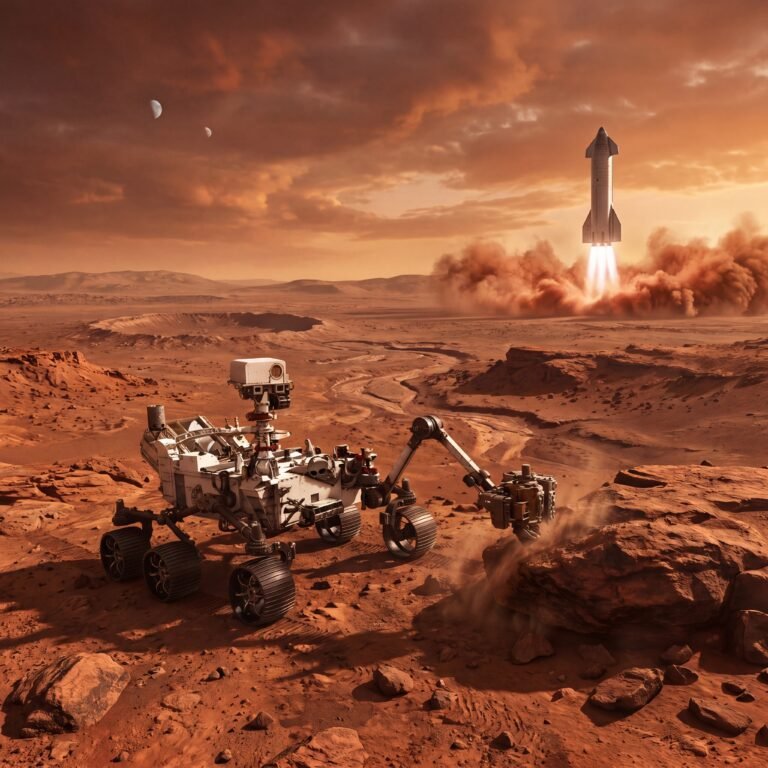
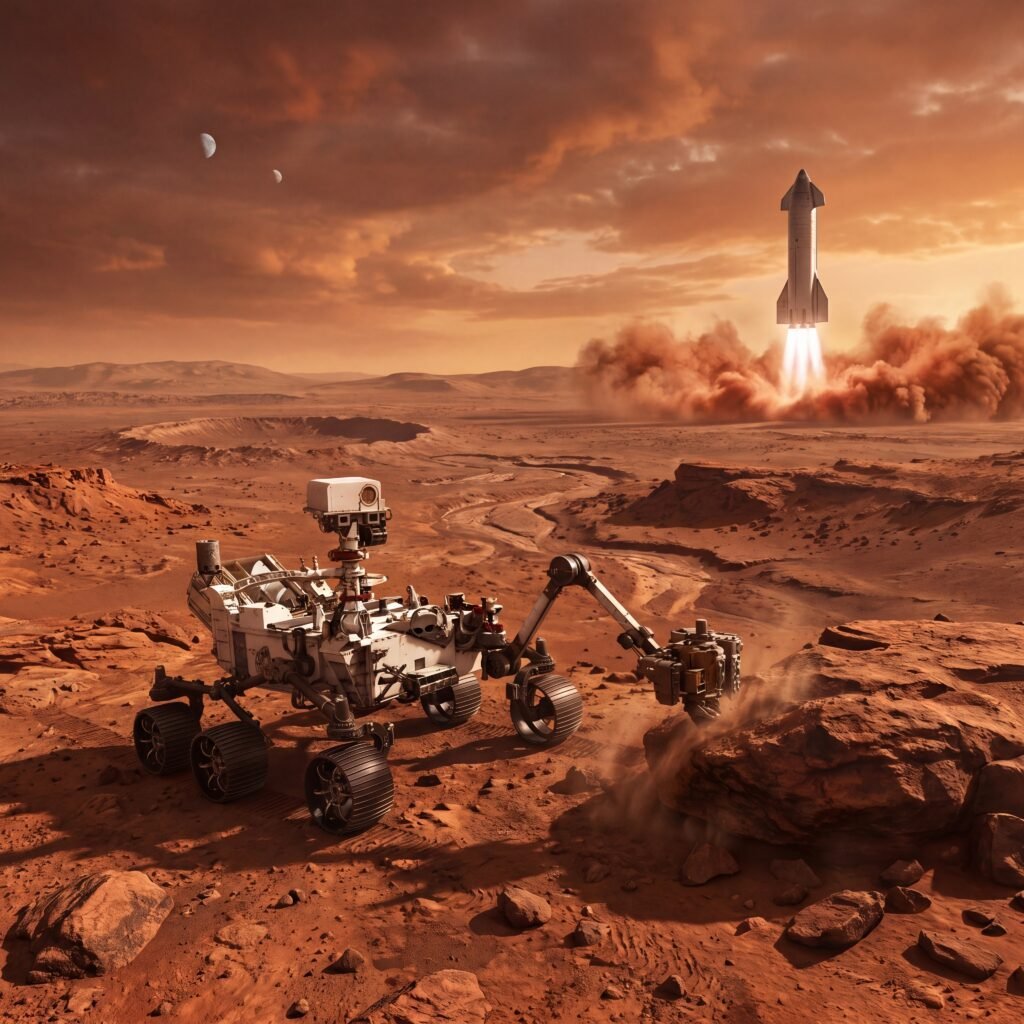
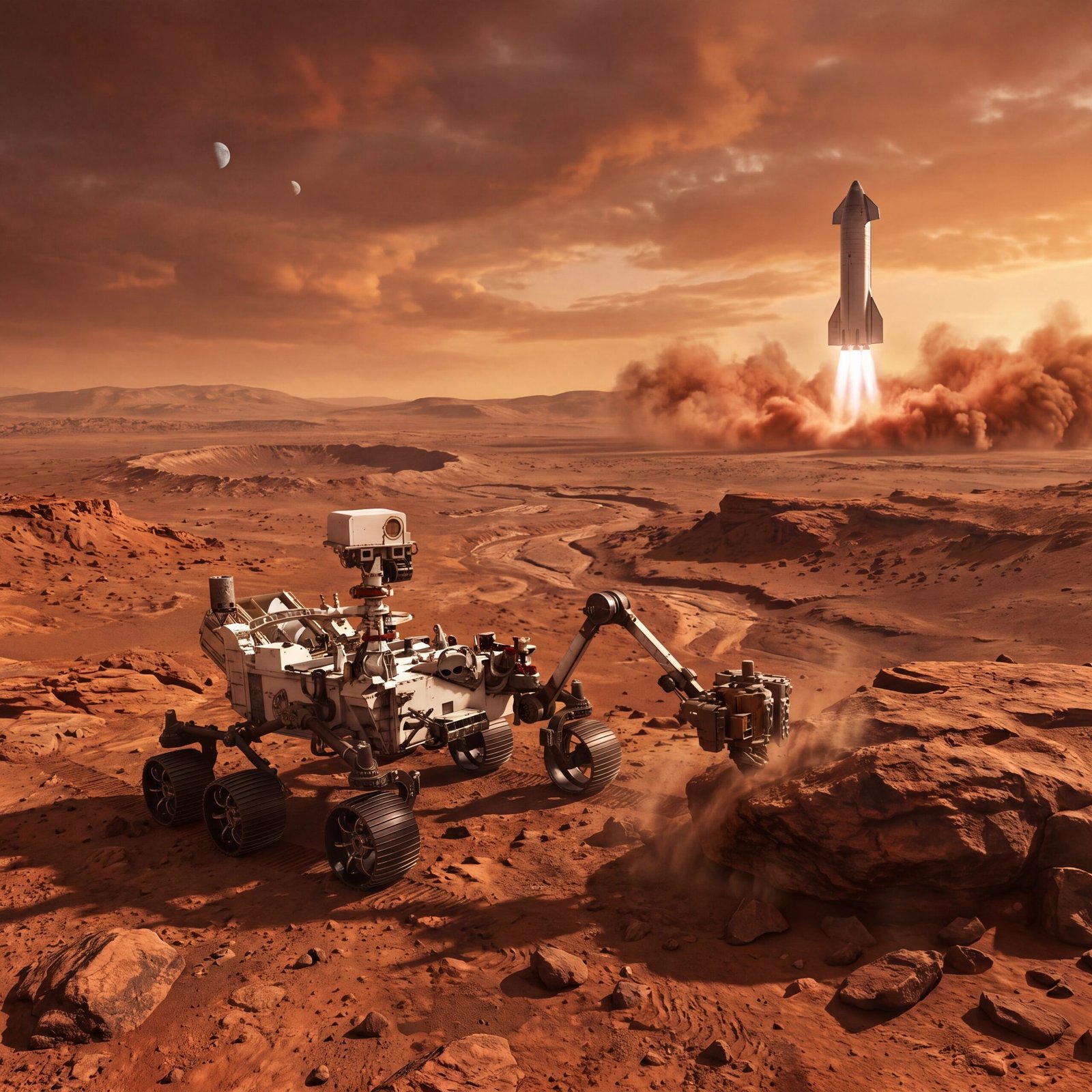
In July 2024, NASA’s Perseverance rover was exploring a rock formation in Jezero Crater — a 45-kilometre-wide impact crater that scientists believe was once a lake, fed by river channels that spilled over its rim and deposited sediment on its floor for hundreds of millions of years. Perseverance drilled into a rock called “Cheyava Falls”, in a formation known as Bright Angel, and extracted a sample that scientists named “Sapphire Canyon.”
When they analysed what was inside, they found something extraordinary.
Along with organic carbon — a building block of life — the team found minuscule specks, dubbed “poppy seeds” and “leopard spots,” that were enriched with iron phosphate and iron sulfide. On Earth, these chemical compounds are byproducts produced when microorganisms break down organic matter.
Perseverance scientist Joel Hurowitz of Stony Brook University, lead author of the study published in the journal Nature, said a “potential biosignature” was detected in rock that formed at a time when Jezero Crater was believed to have been a watery environment — between 3.2 and 3.8 billion years ago.
A potential biosignature. In 3.5-billion-year-old Martian rock.
Acting NASA Administrator Sean Duffy described the finding: “This finding by Perseverance is the closest we have ever come to discovering life on Mars. The identification of a potential biosignature on the Red Planet is a groundbreaking discovery.”
The key word, repeated carefully by every scientist involved, is “potential.” The minerals discovered in the Sapphire Canyon sample can also form through non-biological processes. Scientists who were not involved in the study were quick to point out that non-biological processes could be responsible for the patterns observed.
But here is what makes this finding so significant: for the first time, we have a specific rock sample from a specific place on Mars that contains a specific combination of chemical signatures that, on Earth, are almost exclusively produced by living organisms. It is not proof of life. It is the most compelling hint ever found. And it has set the scientific world on fire.
What Mars Was Like 4 Billion Years Ago
To understand why these findings matter so much, we need to understand what Mars used to be — and how dramatically it has changed.
Mars today is a frozen desert. Its average surface temperature is around minus 60 degrees Celsius. Its atmosphere is 95% carbon dioxide and so thin that liquid water cannot exist on the surface — it would either freeze or instantly evaporate. The planet is bombarded by radiation from the Sun because it lost its global magnetic field billions of years ago.
But Mars has not always been this way. The ancient rock formations that Perseverance is exploring tell a story of a warmer, wetter world. Jezero Crater alone is estimated to have held a lake that persisted for hundreds of millions of years — long enough, by Earth’s standards, for microbial life to not just emerge, but flourish.
Scientists believe the Perseverance team is looking at organic matter that has been preserved on Mars for 3.5 billion years. “It’s really useful to have evidence that ancient organic matter is preserved, because that is a way to assess the habitability of an environment,” said University of Florida scientist Amy Williams, a member of both the Curiosity and Perseverance rover science teams.
The fact that organic matter has survived in Martian rock for 3.5 billion years tells us something important: Mars is a very good place to look for preserved records of ancient life, even if that life is long gone. The cold, dry, radiation-heavy environment that makes Mars inhospitable today is actually excellent at preserving chemical signatures in rock.
The Curiosity Rover’s Bombshell Discovery
Perseverance is not the only rover making headlines. NASA’s older Curiosity rover — which has been exploring Mars since 2012 in a different region called Gale Crater — has also delivered a stunning finding in 2026.
NASA’s Curiosity rover found mysterious life-linked molecules on Mars. “We think we’re looking at organic matter that’s been preserved on Mars for 3.5 billion years,” said Williams, who helped develop the experiment. “It’s really useful to have evidence that ancient organic matter is preserved, because that is a way to assess the habitability of an environment.”
Two separate rovers. Two separate regions of Mars. Both finding preserved organic chemistry from the ancient era when Mars was warm and wet. The picture emerging from the Martian surface is becoming increasingly consistent: billions of years ago, Mars had the chemistry, the water, and the energy to support microbial life. Whether it actually did is the question that only returned samples can definitively answer.
The Problem: We Cannot Answer the Question from Earth
Here is the frustrating truth. Both Perseverance and Curiosity are extraordinary machines, but they have fundamental limitations. They cannot perform the kinds of detailed molecular and isotopic analyses that would definitively confirm or rule out a biological origin for the chemical patterns they are finding.
Scientists note: “We’re now at the limits of what Perseverance can do on the surface. The next chapter depends on bringing these samples home.”
Perseverance has been carefully drilling and sealing rock samples in titanium tubes since it landed in 2021. It currently carries dozens of sealed sample tubes — each one potentially containing preserved evidence of ancient Martian life. But those tubes are sitting on Mars, waiting.
The original plan for Mars Sample Return — a joint NASA and European Space Agency mission to retrieve Perseverance’s samples and bring them to Earth — has been plagued by delays and cost overruns. Initially budgeted at around $3 billion with a target return date of 2033, estimates now range between $6 to $11 billion, pushing possible delivery back to the mid-2030s.
The most important scientific samples ever collected may not reach Earth for another decade or more. Unless someone gets to Mars faster.
SpaceX’s Audacious Plan: Starship Goes to Mars in 2026
Enter Elon Musk and SpaceX — with a plan so bold it has divided the scientific community between excitement and scepticism.
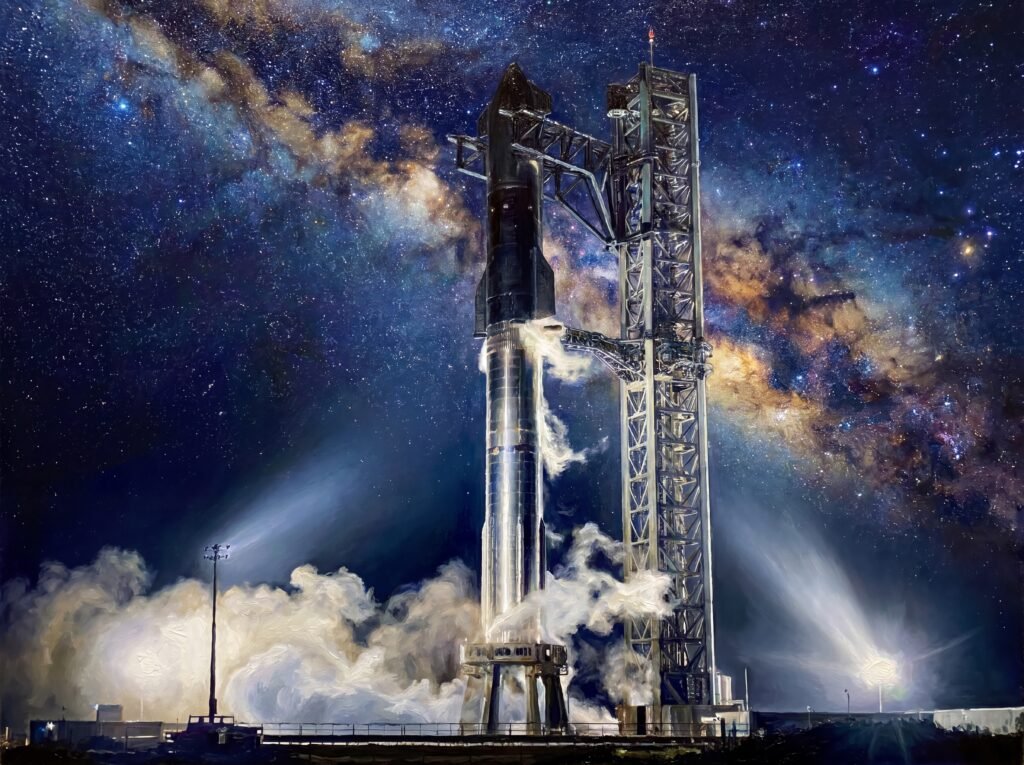
SpaceX plans to start launching uncrewed Mars missions with its Starship megarocket in 2026 and crewed flights to the Red Planet two years after that. “These will be uncrewed to test the reliability of landing intact on Mars. If those landings go well, then the first crewed flights to Mars will be in 4 years,” Musk said.
Musk gave more details, describing a step-by-step approach for landing the first humans as soon as 2029. Five uncrewed Starships would lift off in 2026, the next time the orbits of Earth and Mars are aligned for an efficient transfer.
The reason timing matters so much is simple orbital mechanics. Earth and Mars orbit the Sun at different speeds, meaning the distance between them varies dramatically. Roughly every 26 months, they reach a configuration where the journey between them is shortest and requires the least fuel. This is called a transfer window, and the next one opens in November 2026.
The end of 2026 coincides with a slim window that occurs once every two years when Mars and Earth align around the Sun for the closest trip between the two planets, which would take seven to nine months to transit by spacecraft. The first flight to Mars would carry a simulated crew consisting of one or more Tesla-built humanoid Optimus robots, with the first human crews following in the second or third landings.
Musk gave his company a 50-50 chance of meeting the 2026 deadline. If Starship were not ready by that time, SpaceX would wait another two years before trying again.
Even at 50-50 odds, the ambition is staggering. Starship — which has never left Earth orbit — attempting to land on Mars in the same year it is conducting its very first orbital test flights. If it succeeds, it would be the most dramatic technological leap in the history of space exploration.
Musk envisions eventually launching 1,000 to 2,000 ships to Mars every two years, working toward the eventual target of building a self-sustaining city — with each crewed Starship carrying 100 to 200 passengers.
A self-sustaining city on Mars. Within two decades. It sounds like science fiction. But SpaceX has a track record of making things that sounded like science fiction into reality.
The Challenge of Landing on Mars
Getting to Mars is extraordinarily difficult. Landing on Mars is even harder.
Mars has an atmosphere — but it is about 1% the density of Earth’s. That is thick enough to cause violent heating during atmospheric entry, but thin enough that it provides almost no braking force. A spacecraft descending to Mars must deal with both problems simultaneously: it is on fire from air friction, but it is also still falling at terrifying speed.
Landing Starship on Mars presents extraordinary difficulties. At 52 metres tall and weighing over 200 tons, Starship is roughly 200 times heavier than any previous spacecraft to attempt a Martian landing.
Every spacecraft that has ever successfully landed on Mars — from the Viking landers in 1976 to the Perseverance rover in 2021 — was carefully engineered around Mars’s thin atmosphere, using combinations of heat shields, parachutes, retrorockets, and airbags to slow its descent. Starship, by contrast, is an enormous vehicle designed to land vertically under rocket power alone.
No one has ever tried this on Mars. No one has ever tried anything close to this on Mars. If SpaceX pulls it off in 2026, it will be the single most audacious engineering achievement in the history of planetary exploration.
China’s Plan: Bring Mars Rocks Back to Earth
While SpaceX focuses on getting to Mars fast, China is focused on a different goal: bringing Mars back to Earth.
China has advanced the launch of its Tianwen-3 Mars sample-return mission to 2028 — two years sooner than originally planned — suggesting that China could bring Mars samples to Earth as soon as 2031.
The Tianwen-3 mission is planned for launch in 2028, aiming to return at least 500 grams of Martian samples by 2031. After launch, the probe will take seven to eight months to reach Mars, operate on the planet for about one year, and then return to Earth.
Five hundred grams of Martian rock and soil, brought to Earth laboratories where the world’s best analytical instruments can examine them in exquisite detail. That is enough material to answer, definitively, whether Mars ever hosted life.
The mission has three major scientific goals: searching for the potential signs and tracks of life on Mars, studying the evolution of the habitability of the Red Planet, and understanding Mars’ geological structure and its evolutionary history.
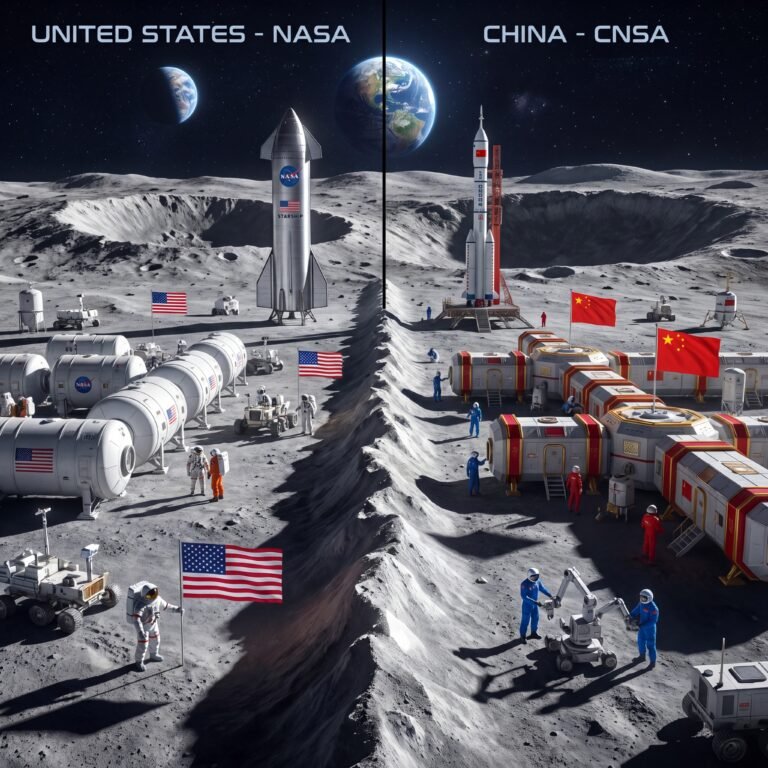
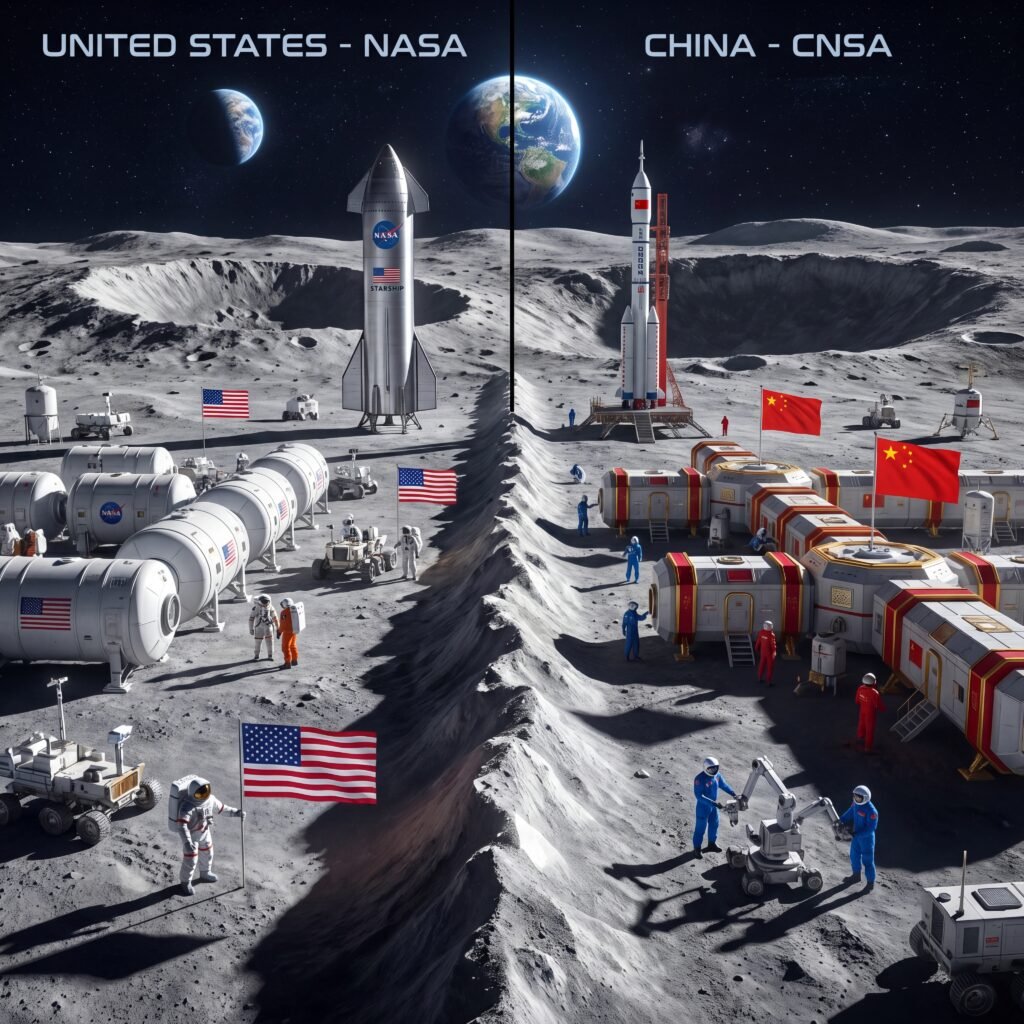
There is now a genuine chance that China could return Martian samples before the US — a scenario that would have seemed unthinkable a decade ago but is now being taken very seriously in Washington.
The Chinese mission uses an innovative approach that minimises contamination risk: unlike Tianwen-1, which used a rover, this mission will deploy a drone for collecting samples remotely. A drill will penetrate two metres into the Martian surface — deeper than any previous sample collection — to retrieve material that has been protected from surface radiation.
Japan’s Phobos Mission: Solving a 4-Billion-Year-Old Mystery
Not to be left out, the Japan Aerospace Exploration Agency is taking a completely different approach to Mars science.
In November 2026, JAXA will launch a mission aiming to achieve something no one has attempted before — landing on one of Mars’s moons and bringing a piece of it back. The Martian Moons Exploration mission, or MMX, aims to answer fundamental questions about Phobos, the larger of Mars’s two tiny moons, which is 27 kilometres wide.
Phobos and Deimos — Mars’s two small, potato-shaped moons — are among the most mysterious objects in the solar system. Scientists do not know where they came from. Are they captured asteroids? Or were they blasted off Mars itself by a giant impact billions of years ago? The answer matters enormously for understanding the early solar system.
MMX will orbit Mars, conduct multiple close flybys of Phobos, land on its surface, collect samples, and return them to Earth. It will also observe Deimos and monitor Mars’s climate. It is one of the most ambitious planetary science missions ever attempted — and it launches at the same transfer window as SpaceX’s Starship.
November 2026 may be the busiest Mars departure season in history.
What We Know About Mars Today
Beyond the search for ancient life, Mars science has been quietly advancing on multiple fronts in 2025 and 2026.
Scientists now have strong evidence that Mars had not one but multiple periods of warmth and liquid water — separated by cold, icy epochs. The planet’s climate history was far more complex than the simple “warm and wet early, cold and dry later” story that dominated Mars science for decades.
The ancient volcano Olympus Mons — the largest volcano in the solar system, three times the height of Mount Everest — may have been active far more recently than previously thought, raising questions about whether Mars’s interior is truly as geologically dead as scientists assumed.
And new measurements of Mars’s thin atmosphere suggest it still holds surprises. Seasonal variations in methane — a gas that on Earth is produced primarily by biological processes — have continued to puzzle scientists. The methane signal on Mars remains unexplained, and while geological processes are the most likely source, the biological explanation has not been ruled out.
The Next Decade on Mars
Looking ahead, Mars is about to become one of the busiest places in the solar system.
If SpaceX’s Starship lands on Mars in 2026 or 2028, the first cargo missions will begin establishing what Musk calls a “propellant depot” — producing fuel from Martian water and carbon dioxide, enabling return flights and supporting future crewed missions. The first humans on Mars would follow, potentially as early as 2029 or 2030.
China’s Tianwen-3 will bring back the first Mars samples in 2031, enabling the most detailed analysis of Martian material ever conducted. If those samples contain preserved biosignatures consistent with ancient life, the scientific and cultural impact will be unlike anything humanity has experienced since the Apollo astronauts brought back moon rocks in 1969.
NASA’s Perseverance will continue collecting samples, exploring new terrain, and building the most comprehensive geological record ever assembled for another world. Its sample tubes — sitting sealed and waiting on the Martian surface — represent a scientific treasure trove that will eventually make their way to Earth.
And somewhere on Mars, in the layers of ancient sediment that were once the bottom of a lake, in the chemistry preserved in billion-year-old rocks, the answer to humanity’s oldest question is waiting to be found.
The Bottom Line
Mars in 2026 is not the distant, mysterious red dot of mythology. It is an active frontier — visited by robots, targeted by rockets, and yielding secrets it has held for billions of years.
A NASA rover has found what may be the chemical fingerprint of ancient Martian life. SpaceX is targeting a Starship launch to the planet before the year is out. China is preparing a mission to bring Mars rocks back to Earth. Japan is heading to Mars’s mysterious moon. And somewhere in the red dust of Jezero Crater, sealed in titanium tubes, sit rock samples that could answer the question that has defined human curiosity since the dawn of civilisation.
Are we alone?
Musk captured the magnitude of the moment: “Flight rate will grow exponentially from there, with the goal of building a self-sustaining city in about 20 years.”
The Red Planet is no longer just a destination. It is becoming humanity’s next home.
And the journey begins in 2026.
🌐 Follow neboda.ai for daily Mars updates, SpaceX mission news, and the greatest exploration story ever told.