
Somewhere in the outer solar system, beyond the asteroid belt, past the colossal storms of Jupiter, there is a world covered entirely in ice.
From the outside, it looks dead. Frozen. Lifeless. A cracked, rust-streaked ball of ice the size of Earth’s Moon, lit only by the cold distant glow of a Sun that is five times farther away than it is from us.
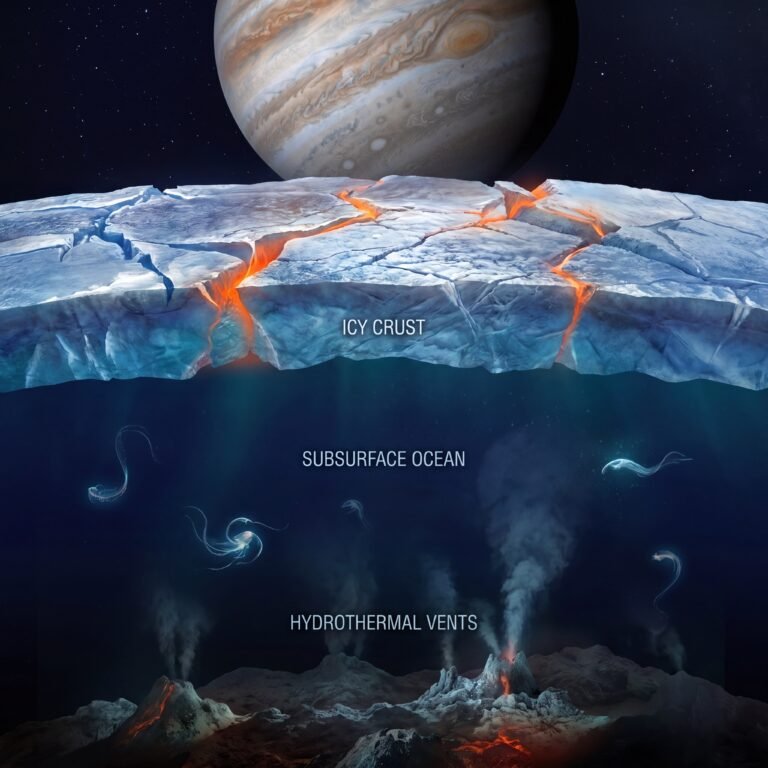
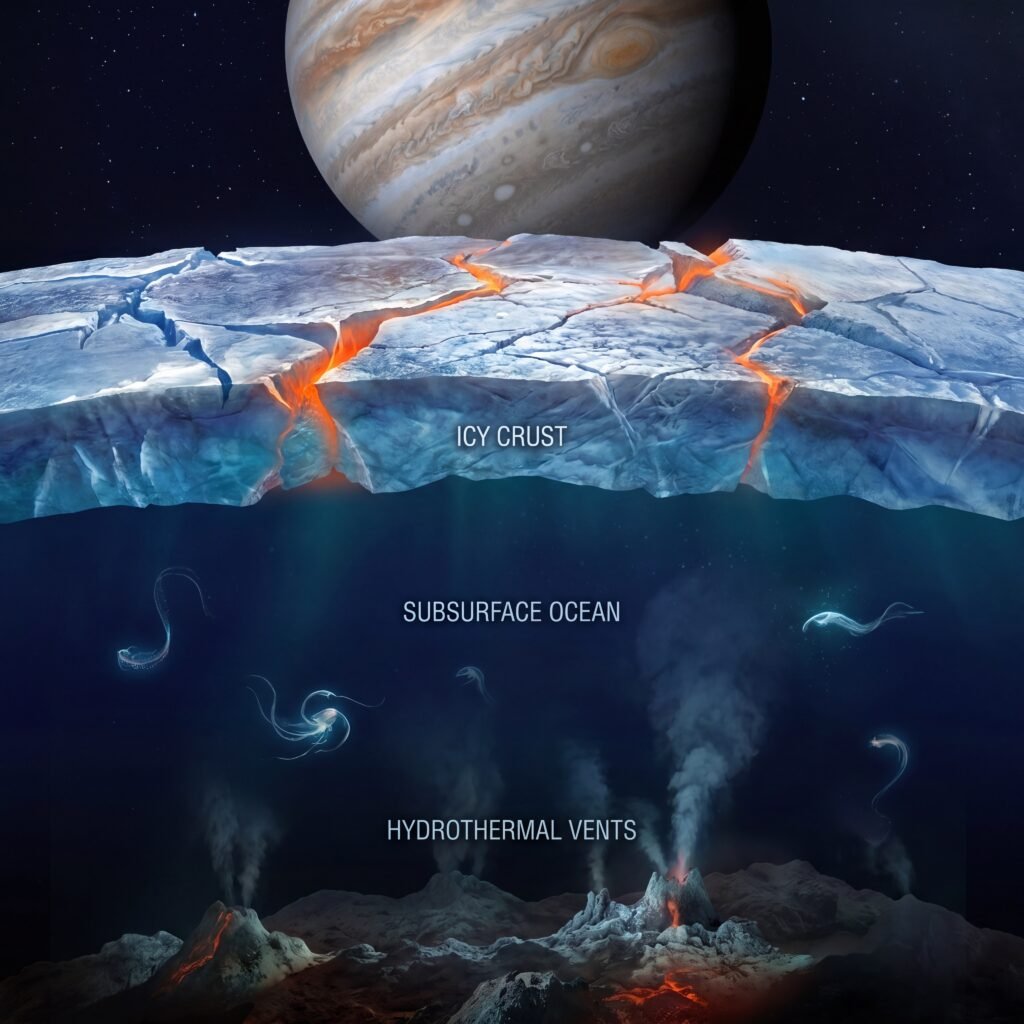
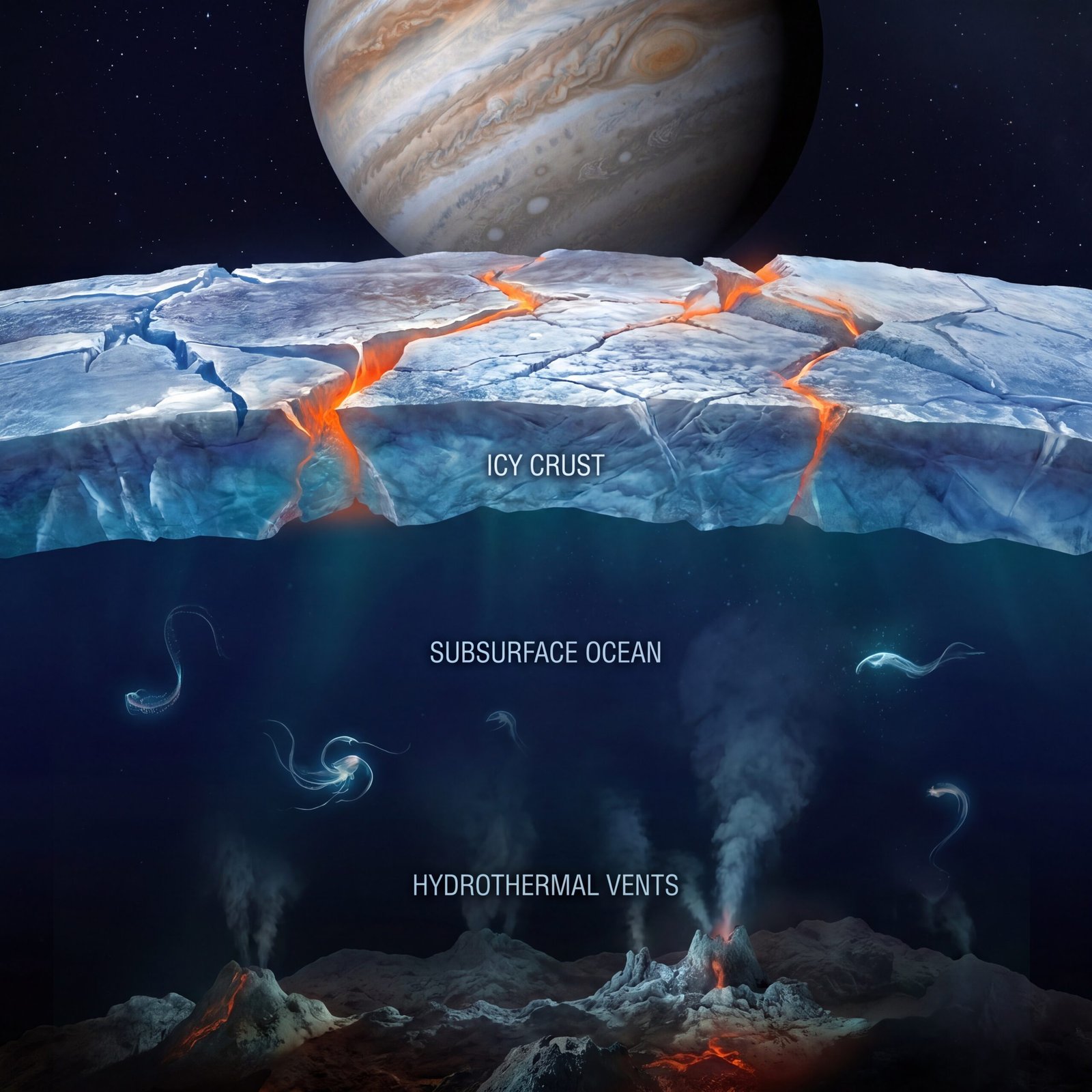
But beneath that ice — beneath a frozen shell that may be ten to fifteen miles thick — scientists believe something extraordinary exists.
An ocean.
Not a small ocean. Not a pond. A vast, global, saltwater ocean that may contain twice as much liquid water as all of Earth’s oceans combined. An ocean that has almost certainly been liquid for billions of years. An ocean that sits in total darkness, warmed not by sunlight but by the tidal forces of the largest planet in the solar system pulling and squeezing the moon’s rocky interior.
An ocean where — just possibly — something is alive.
This is Europa. And right now, the largest spacecraft NASA has ever sent to another planet is on its way there to look.
What Exactly Is Europa?
Europa is one of Jupiter’s 95 known moons — the sixth largest moon in the solar system and one of the four large moons discovered by the Italian astronomer Galileo Galilei in 1610 when he first turned a telescope toward Jupiter.
For most of the 400 years since its discovery, Europa was just another dot of light. A number in a catalogue.
That changed in the 1990s, when NASA’s Galileo spacecraft flew past Europa and its instruments detected something that set the scientific world on fire: evidence of a massive saltwater ocean beneath the moon’s icy surface.
Beneath its thick shell of ice, scientists believe Europa contains an enormous ocean of salty liquid water — a possibility that has fueled decades of speculation about whether Europa could host life, placing it among the most important targets for exploration in the solar system.
Evidence suggests Europa has a saltwater ocean possibly 40 to 100 miles deep, which means it could contain about twice as much water as Earth’s oceans.
Read that number again. Twice as much liquid water as every ocean, sea, lake, river and glacier on Earth. All of it, hidden beneath a frozen shell, in the dark, around a moon of Jupiter, 500 million miles from our Sun.
Why Scientists Think Something Might Live There
The question of life on Europa begins with a simple principle that has guided astrobiology since its earliest days:
Follow the water.
Life as we know it requires liquid water. Every living thing on Earth — from bacteria in deep ocean trenches to redwood trees to human beings — depends fundamentally on liquid water. So when scientists discovered a global ocean on Europa, the question of life immediately followed.
But water alone is not enough. Life also needs energy and chemistry — a source of power to drive biological processes and the right chemical ingredients to build and sustain living cells.
Here is where Europa becomes particularly interesting.
On Earth, life exists not only at the warm, sun-lit surface but also in the deepest, darkest parts of the ocean floor — at hydrothermal vents, where superheated water rich in minerals gushes up from cracks in the seafloor. These ecosystems have no sunlight whatsoever. They are powered entirely by the heat and chemistry of the Earth’s interior. And they teem with life — bacteria, tube worms, shrimp, crabs, entire food webs built on chemical energy rather than sunlight.
If life can thrive in the pitch-black depths of Earth’s oceans with no sunlight, powered only by heat from below — why couldn’t it do the same in Europa’s ocean?
If oxygen-containing materials can move from Europa’s surface down into the ocean, they could react with chemicals from the seafloor. In this way, Europa’s ocean could have the chemical energy to power life.
That is the promise of Europa. Not life at the surface — there is no surface life possible in the radiation-blasted, airless, frozen conditions there. But life in the deep ocean, powered by tidal heating and seafloor chemistry, completely independent of sunlight, just as deep-sea organisms are on Earth.
The Ice Shell: A Window Into the Ocean Below
One of the most visually striking things about Europa is its surface. Unlike most moons, which are covered in craters from billions of years of meteor impacts, Europa’s surface is remarkably smooth — and covered in a breathtaking network of cracks, ridges, and rust-colored streaks that crisscross the ice like veins on a leaf.
Europa’s surface is crisscrossed by long, linear fractures, cracks, ridges, and bands. This ice shell is probably 10 to 15 miles thick.
Those rust-colored streaks are particularly significant. Scientists believe they are composed of salts and minerals that have welled up from the ocean below through the fractured ice — essentially, chemical traces of the ocean leaking to the surface through the cracks.
If that is true, then the surface of Europa carries a chemical fingerprint of whatever is in the ocean below. And spacecraft flying over those streaks can, in principle, taste what is in that hidden ocean by analyzing the material left behind on the surface.
There is also the question of plumes. Saturn’s moon Enceladus famously erupts with towering geysers of water vapor from its south pole — geysers that contain organic molecules and carry ocean material directly into space, where passing spacecraft can fly through and sample it directly.
Scientists have long wondered if Europa does the same thing. A 2014 paper presented exciting results suggesting that intermittent plumes of water vapor were escaping through Europa’s icy shell, reaching 200 km above Europa’s surface.
But the story has become more complicated. New research from the original discoverers has reanalyzed 14 years of Hubble telescope data and cast doubt on previous evidence suggesting that the icy moon intermittently discharges faint water plumes. “The evidence for water vapor plumes on Europa isn’t as strong as we first understood it,” said SwRI’s Dr. Kurt Retherford.
“No localized emission enhancements were detected in any of the observations, including the image previously interpreted as evidence of water aurora near Europa’s south pole,” the authors write.
So the plumes remain unconfirmed — tantalizing but not yet proven. This is exactly the kind of question that the Europa Clipper mission is designed to answer definitively.
NASA’s Europa Clipper: The Largest Planetary Spacecraft Ever Built
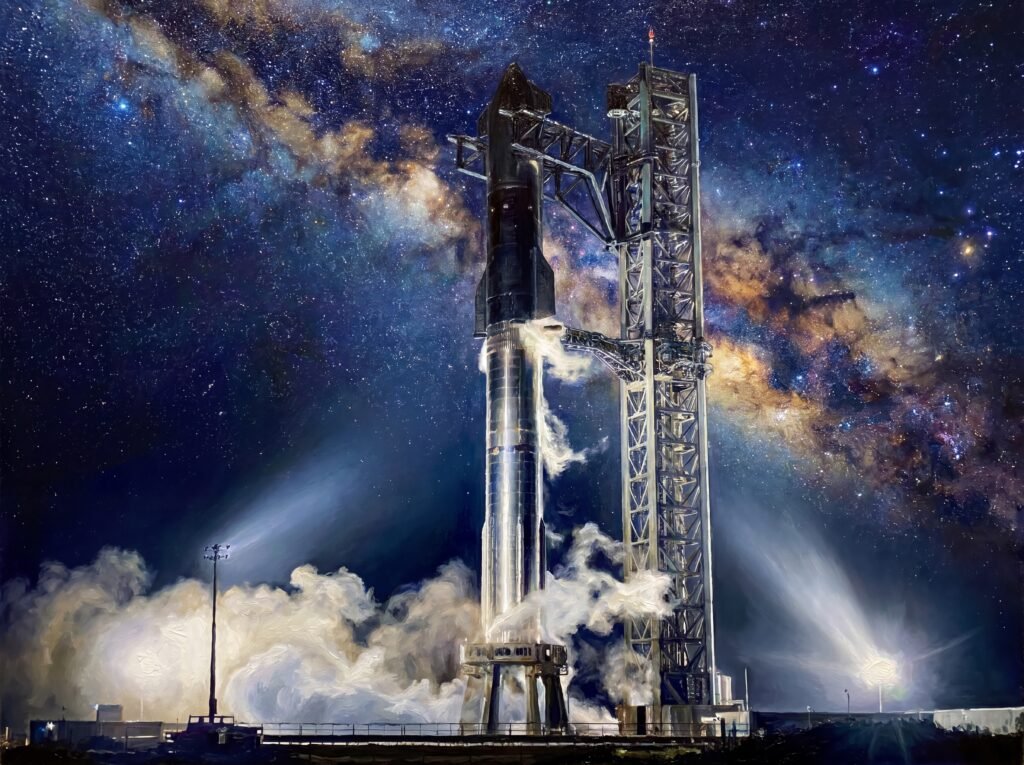
On October 14, 2024, atop a SpaceX Falcon Heavy rocket at Kennedy Space Center, NASA launched the most ambitious mission in the history of planetary science.
The largest spacecraft NASA ever built for a mission headed to another planet, Europa Clipper is also the first NASA mission dedicated to studying an ocean world beyond Earth.
The Europa Clipper spacecraft spans about the size of a basketball court — 82 feet between the tips of its solar-array wings. It carries nine sophisticated science instruments enclosed in a radiation-hardened vault designed to survive Jupiter’s ferocious radiation belts, which are powerful enough to damage unprotected electronics within hours.
The spacecraft will travel 1.8 billion miles on a trajectory that leverages gravity assists — first to Mars and then back to Earth for another gravity assist flyby. After it begins orbiting Jupiter in April 2030, the spacecraft will fly past Europa 49 times.
Forty-nine close passes over Europa. Each one a chance to peel back another layer of mystery from this extraordinary world.
Nine Instruments, One Question: Is There Life?
The nine instruments aboard Europa Clipper represent the best tools humanity has ever designed for investigating an ocean world. Each one addresses a different piece of the habitability puzzle.
Europa Clipper has a powerful suite of nine science instruments designed to work together to study Europa’s surface features, improve our understanding of the moon’s icy shell, examine the interaction between the ocean and the icy shell, and investigate the ocean’s composition to determine if it has the ingredients to sustain life.
Here is what each instrument will do:
Cameras and Spectrometers: The Europa Imaging System contains wide-angle and narrow-angle cameras that will produce high-resolution color and stereoscopic images of Europa, studying its geologic activity and measuring surface elevations.
Thermal Imager: The Europa Thermal Emission Imaging System will use infrared light to measure surface texture and characterize warmer regions where the liquid ocean may be closer to the surface. Warmer spots could indicate places where the ice is thinnest and the ocean is nearest — potentially the best landing sites for a future lander.
Ice-Penetrating Radar: An ice-penetrating radar will search for subsurface lakes similar to those beneath Antarctica’s ice sheet. This instrument can effectively see through the ice, mapping the structure of the shell and looking for pockets of liquid water trapped within it.
Magnetometer: A magnetometer and a plasma instrument will measure the strength and direction of the moon’s induced magnetic field, which will allow scientists to confirm the existence of Europa’s subsurface ocean and determine its characteristics — including depth and salinity. The salinity of the ocean is particularly important — salty water is more electrically conductive, and conductivity shows up in the magnetic field measurements.
Ultraviolet Spectrograph: Europa Clipper’s ultraviolet spectrograph will search for potential plumes of water vapor that might erupt from Europa’s surface and provide data on the composition and dynamics of the moon’s thin atmosphere. It will primarily identify relatively simple molecules such as hydrogen, oxygen, hydroxide, and carbon dioxide.
Mass Spectrometer and Dust Analyzer: Additional instruments will characterize the composition of gases and tiny particles in the moon’s thin atmosphere — and search for potential plumes of water vapor that might erupt from the moon’s surface. If plumes exist and Europa Clipper flies through one, the mass spectrometer could directly analyze ocean material erupted into space — potentially detecting organic molecules, the chemical building blocks of life.
All science instruments will operate simultaneously on every pass. Every single flyby will generate a complete multi-instrument dataset of Europa. Over 49 flybys, the picture that emerges will be the most detailed portrait ever painted of another ocean world.
The Controversy: Is Europa’s Ocean Actually Lifeless?
Not everyone is optimistic about Europa’s life potential. And in 2026, a significant new study landed that threw cold water — appropriately enough — on some of the excitement.
Researchers from Washington University in St. Louis said on January 6, 2026, that Europa’s seafloor likely lacks the geologic activity needed to sustain life. In fact, the study suggests that Europa’s seafloor might be “quiet and lifeless.”
Lead researcher Paul Byrne said: “If we could explore that ocean with a remote-control submarine, we predict we wouldn’t see any new fractures, active volcanoes, or plumes of hot water on the seafloor. Geologically, there’s not a lot happening down there. Everything would be quiet.”
The logic behind this finding is based on Europa’s size and structure. By modeling Europa’s size, internal structure, and the gravitational pull exerted by Jupiter, Byrne and his colleagues found little evidence for tectonic movement, hydrothermal vents, or other energy sources typically linked to habitable environments.
On Earth, the geological activity that powers deep-sea life comes from the movement of tectonic plates — which generates volcanic activity, hydrothermal vents, and a constant chemical exchange between the rocky seafloor and the ocean above. Europa, this new study suggests, may lack sufficient tidal heating to drive that kind of geological activity.
Without hydrothermal vents, without active geology, without a chemical energy source on the seafloor — could life survive?
It is a sobering question. But it is not the final word.
Even if future evidence shows that Europa’s ocean is lifeless today, Byrne says the effort will still be worthwhile. “I’m not upset if we don’t find life on this particular moon. I’m confident that there is life out there somewhere, even if it’s 100 light-years away. That’s why we explore — to see what’s out there.”
And critically, this study is based on models — mathematical simulations of Europa’s interior. The Europa Clipper mission will provide actual measurements — direct observations — that will either support or overturn these models. Science does not end with one study. It advances through evidence.
What Happens If Europa Clipper Finds Signs of Life?
This is the question that keeps astrobiologists both thrilled and awake at night.
Europa Clipper is not a life-detection mission. Its primary science goal is to explore Europa to investigate its habitability — to determine whether there are places below Europa’s surface that could support life. It carries no instruments specifically designed to detect living organisms.
But suppose its mass spectrometer flies through a plume and detects complex organic molecules — the kind that, on Earth, are produced by biological processes. Suppose its radar reveals a warm, shallow pocket of liquid water just beneath the surface, teeming with chemical activity. Suppose its magnetometer reveals a saltwater ocean with exactly the right chemical composition to sustain life.
None of those findings would prove life exists. But all of them together would make the case for life on Europa overwhelming — and would build the scientific and political justification for the next step: a lander mission specifically designed to drill through the ice, reach the ocean, and look for living organisms directly.
If plumes exist, Europa Clipper may be able to fly through one and directly sample material from Europa’s ocean. “If the plumes are there, there’s a very high chance we’ll detect them,” said NASA planetary scientist Lynnae Quick.
The discovery of life on Europa — even microbial life, even single-celled organisms in a dark ocean around Jupiter — would be the most important discovery in the history of science. It would prove, beyond any doubt, that life is not unique to Earth. It would transform our understanding of our place in the universe and answer the oldest question humanity has ever asked: are we alone?
The Journey Continues
Right now, as you read this, Europa Clipper is somewhere between Earth and Jupiter, traveling 1.8 billion miles through the cold dark of the solar system.
The spacecraft will leverage gravity assists — first past Mars, then back to Earth — before hurtling on to Jupiter, where it is scheduled to arrive in April 2030.
Four years from now, it will begin its close flybys of Europa. And what it finds in those 49 close passes will either confirm one of the most exciting possibilities in the history of planetary science — or force us to look elsewhere.
NASA planetary scientist Lynnae Quick captured the spirit of the mission perfectly: “We’re going to see things that we’ve never seen before.”
The Bottom Line
Europa is a world of contradictions. Frozen on the outside and potentially warm and wet within. Seemingly dead from a distance and potentially teeming with life in its hidden depths. A moon of Jupiter that may hold more liquid water than all of Earth’s oceans combined — and perhaps, within that water, the answer to the question that has haunted humanity since we first looked up at the stars.
As former NASA Administrator Bill Nelson said at Europa Clipper’s launch: “By exploring the unknown, Europa Clipper will help us better understand whether there is the potential for life not just within our solar system, but among the billions of moons and planets beyond our Sun.”
The universe is full of oceans. We have just found one of the closest. And we have sent our best spacecraft to find out if anyone is home.
April 2030 cannot come soon enough.
🌐 Follow neboda.ai for the latest on Europa Clipper, the search for extraterrestrial life, and the greatest scientific mission of our generation.