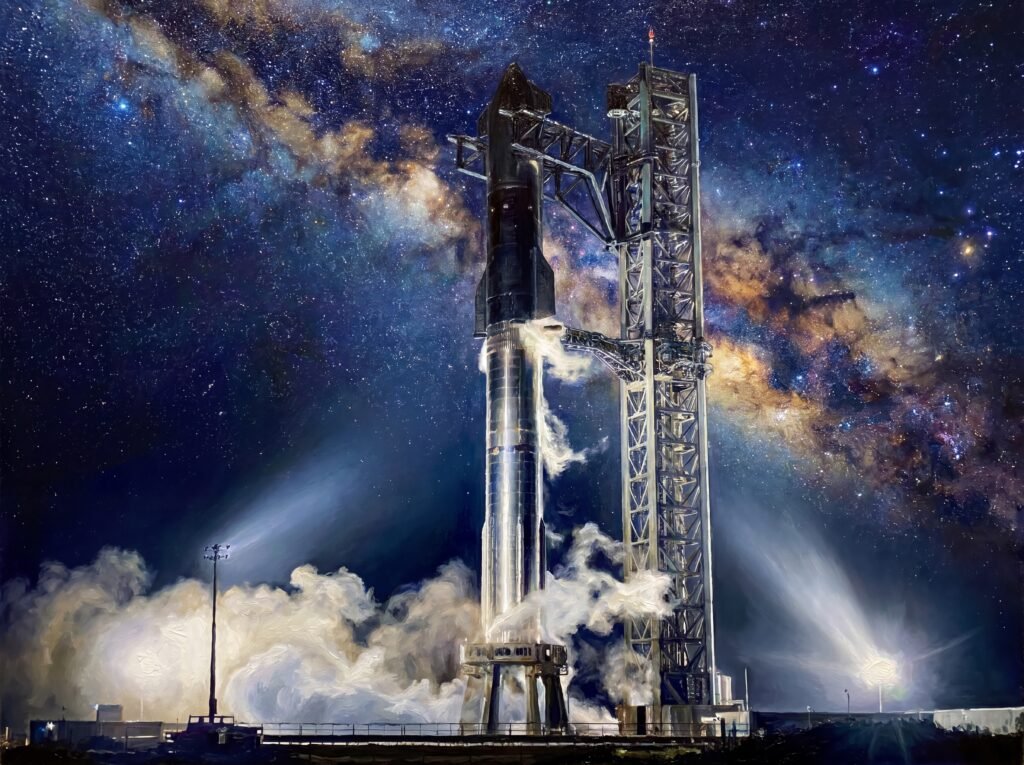

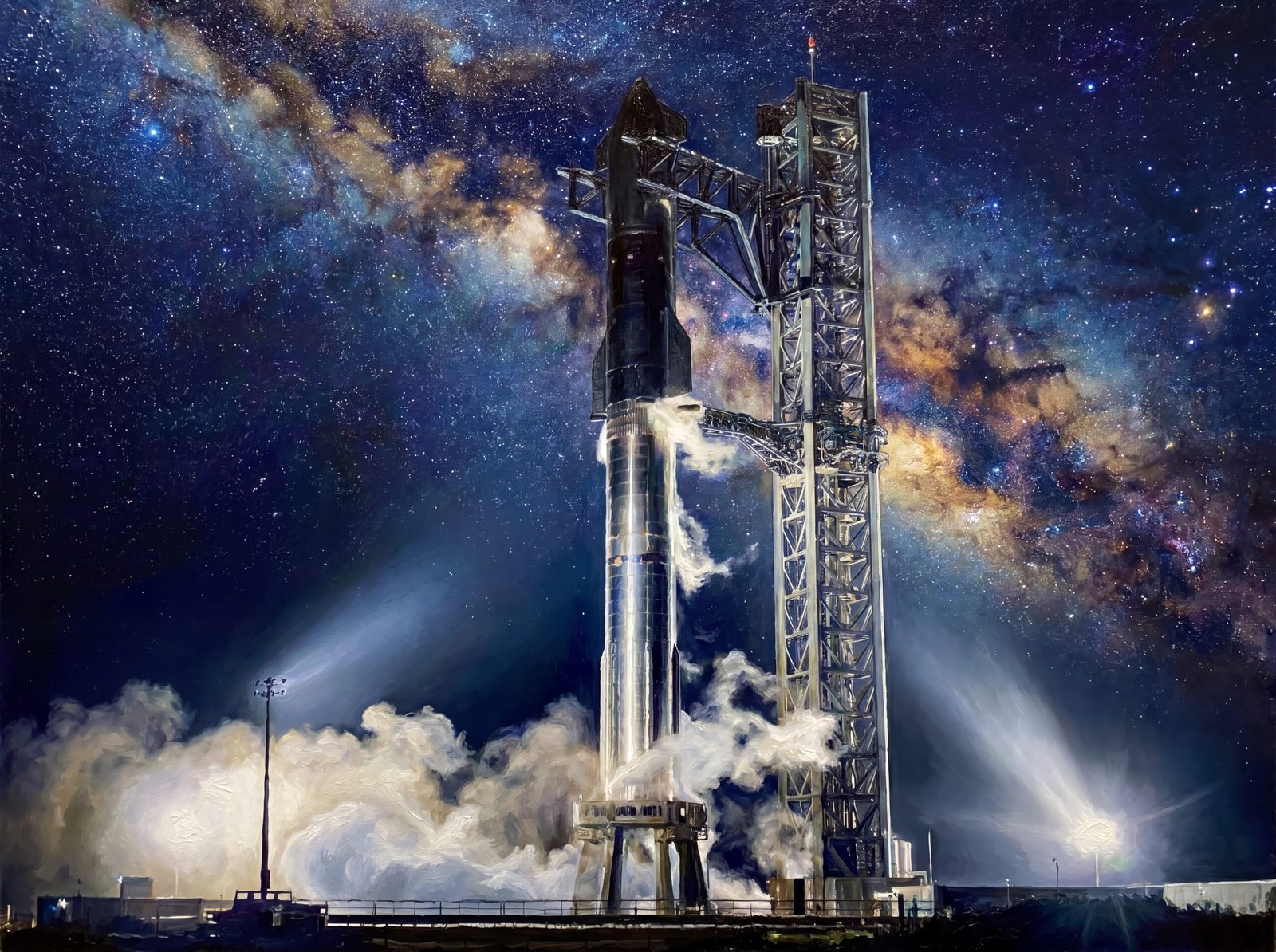
The ground shakes. The sky turns orange. And somewhere over the Gulf of Mexico, the most powerful rocket ever assembled by human hands begins its journey toward the stars.
SpaceX’s Starship Flight 12 isn’t just another test. It’s the debut of an entirely new generation of the world’s biggest rocket — Starship V3 — and if you’re not paying attention, you’re missing one of the most important moments in the history of spaceflight.
Here’s everything you need to know about what’s happening, why it matters, and what comes next.
What Is Starship, and Why Does Everyone Keep Talking About It?
Before we dive into Flight 12, let’s make sure we’re all on the same page.
Starship is SpaceX’s fully reusable super-heavy-lift launch vehicle. It’s designed to carry humans and cargo to the Moon, to Mars, and eventually to destinations across the solar system. It’s also the rocket that NASA has chosen to land astronauts on the Moon for the Artemis III mission.
The entire system stands 124 meters (about 40 stories) tall and consists of two parts:
- Super Heavy Booster — the giant first stage with 33 Raptor engines that blasts the stack off the ground
- Starship upper stage (Ship) — the spacecraft itself, which continues into space after the booster separates
Starship can carry up to 100,000 kilograms of payload to low Earth orbit, making it the most powerful operational rocket in human history.
And with Flight 12, it just got a whole lot better.
What Makes Starship V3 Different?
This is not your grandfather’s Starship. Starship V3 — the vehicle debuting on Flight 12 — represents a sweeping redesign across nearly every major system.
1. Raptor 3 Engines
The Raptor 3 engines used in Starship V3 provide higher thrust while being lighter and simpler than their predecessors. In the world of aerospace engineering, making an engine more powerful and simpler at the same time is extraordinarily difficult. SpaceX has done exactly that.
Fewer moving parts means fewer failure points. Higher thrust means more payload capacity. And lighter engines mean the rocket itself can carry more to orbit.
2. Redesigned Booster with Three Grid Fins
The main changes include a reduction to only three larger and stronger grid fins on the booster with an integrated hot-staging design that removes the expendable interstage.
Grid fins are the large deployable fins that help steer the booster back to its landing target. By going from four smaller fins to three larger ones, SpaceX has improved control authority while reducing weight. The integrated hot-staging design — where the upper stage ignites its engines while still attached to the booster — has proven to increase efficiency significantly.
3. Simplified Aft Sections
Both the booster and ship have significantly simplified aft sections with fewer shrouds and improved thermal protection. Fewer components means faster manufacturing, easier inspection, and quicker turnaround between flights. SpaceX’s long-term vision is to launch Starship dozens of times per year — like an airliner, not a traditional rocket.
4. Increased Propellant Capacity and Orbital Refueling Hardware
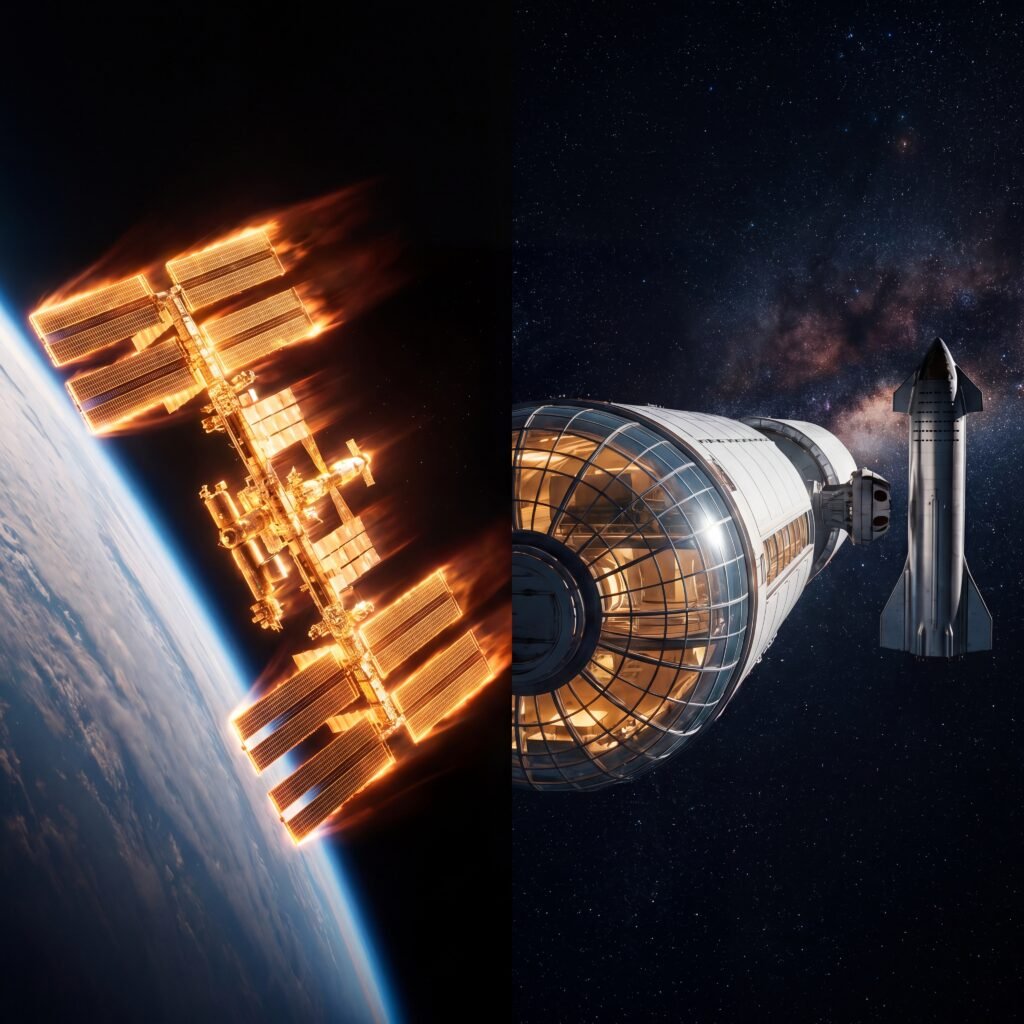
Starship V3 also features increased propellant capacity and new hardware to prepare for future orbital refueling.
This is enormous. NASA’s Artemis lunar lander architecture requires Starship to refuel in orbit before heading to the Moon. The new hardware brings that capability one major step closer. Without orbital refueling, there is no Moon landing. Without a Moon landing, there is no Artemis III.
5. The New Pad 2 at Starbase
The new Pad 2 offers faster fueling and a more durable flame diverter designed for higher launch cadence.
SpaceX’s second launch pad at Starbase in South Texas isn’t just a backup — it’s a major upgrade. A more durable flame diverter means the pad can support more launches without requiring extensive repairs between flights. The upgrades focus on simplification, increased performance, and laying the groundwork for rapid reusability.
What Happened on Flight 12 Launch Day?
SpaceX stacked Starship V3 ahead of Flight 12 on May 19, 2026. The company then ran the vehicle through a full wet dress rehearsal — a simulated countdown complete with full propellant loading — to ensure all systems were working correctly.
SpaceX confirmed a launch window opening at 5:30 PM CST (2330 UTC) on May 21, with a 1.5-hour duration.
The weather, however, was a significant concern. The current weather forecast stood at just 45% favorable for liftoff at window open — though forecasters expected conditions to improve later in the afternoon.
Then, just before liftoff, came the disappointing news. Starship Flight 12’s May 21 launch attempt was scrubbed due to a hydraulic pin issue that prevented a tower arm from retracting during the countdown. Elon Musk confirmed the fault on X, explaining that if the problem could be resolved overnight, SpaceX would make another launch attempt.
This is the nature of spaceflight. Rockets are extraordinarily complex machines. A single unexpected failure in any of thousands of interconnected systems can — and should — halt a launch. Safety always comes first.
What Will Starship Do on Flight 12?
The flight plan for Flight 12 is ambitious. The flight test’s primary goal is to demonstrate each of the new V3 systems in the flight environment for the first time, with each element of the Starship architecture featuring significant redesigns to enable full and rapid reuse.
Starlink Simulator Deployment
Ship 39 will deploy 22 Starlink simulators, similar in size to next-generation Starlink satellites, into the same suborbital trajectory as the Ship itself.
This is a significant step. Starship is ultimately designed to replace Falcon 9 as SpaceX’s workhorse for deploying Starlink satellites. Testing the deployment mechanism now — even with simulators — helps validate the process.
Heat Shield Scanning Technology
The last two satellites deployed will scan Starship’s heat shield and transmit imagery down to operators to test methods of analyzing Starship’s heat shield readiness for return to launch site on future missions.
Think about what this means. Currently, ground crews must physically inspect the heat shield after every flight. By having satellites scan the shield while the vehicle is still in space, SpaceX could eventually determine if a vehicle is ready to fly again before it even lands. This is a game-changer for rapid reusability.
Booster Catch and Ship Splashdown
Recovery for the booster is planned via tower catch, with the Ship targeting an ocean splashdown.
The “tower catch” is one of the most visually stunning achievements in modern rocketry. Rather than landing on legs, the 70-meter Super Heavy booster returns to the launch tower and is grabbed by two giant mechanical arms — nicknamed “Mechazilla” — that halt its descent. The speed and precision required are breathtaking.
The Surprise Announcement: A Human Flyby of Mars
Just as the world was watching for Flight 12, SpaceX dropped another bombshell.
Cryptocurrency billionaire Chun Wang — commander of the private Fram2 Dragon mission — announced that he will lead the first Starship crewed flyby of Mars, which will also swing by the Moon.
Wang said: “A lot of people talk about Mars. We like Mars, we’re gonna land on Mars. We’re gonna do a colony on Mars, but let’s get it started with a flyby.”
A Mars flyby mission on Starship would be the farthest any human has ever traveled from Earth — by an enormous margin. The Moon is roughly 384,000 kilometers away. Mars, at its closest approach, is about 54.6 million kilometers away.
This announcement signals that SpaceX is serious about human deep-space exploration on a faster timeline than anyone outside the company expected.
Why Does This Matter for the Future of Humanity?
You might be reading this and thinking: okay, it’s a big rocket. Why should I care?
Here’s why.
Access to space drives civilizational progress. Weather forecasting, GPS navigation, internet connectivity, climate monitoring, disaster response — all of these depend on satellites in orbit. Cheaper, more capable rockets mean more satellites, better data, and better outcomes for everyone on Earth.
Human survival depends on becoming a multi-planetary species. This isn’t philosophy — it’s mathematics. A civilization confined to a single planet is vulnerable to extinction events: asteroid impacts, pandemics, nuclear war, climate collapse. Starship is the vehicle that makes humanity a multi-planetary species within our lifetimes.
The economics are transformational. Traditional rockets cost hundreds of millions of dollars per launch and are discarded after one use. Starship, when fully reusable, could reduce the cost of getting to orbit by a factor of 100 or more. That changes everything — from scientific research to commercial industry to national security.
What Comes After Flight 12?
Flight 12 is a crucial stepping stone, but it’s not the destination. Here’s what the roadmap looks like:
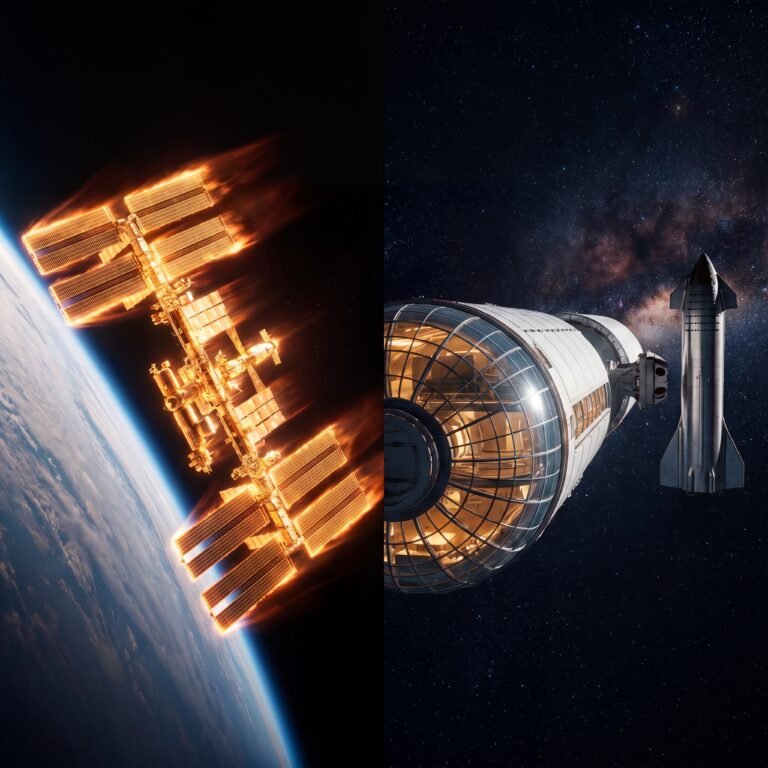
- Orbital refueling demonstrations — multiple Starship vehicles meeting in orbit to transfer propellant, enabling lunar and Mars missions
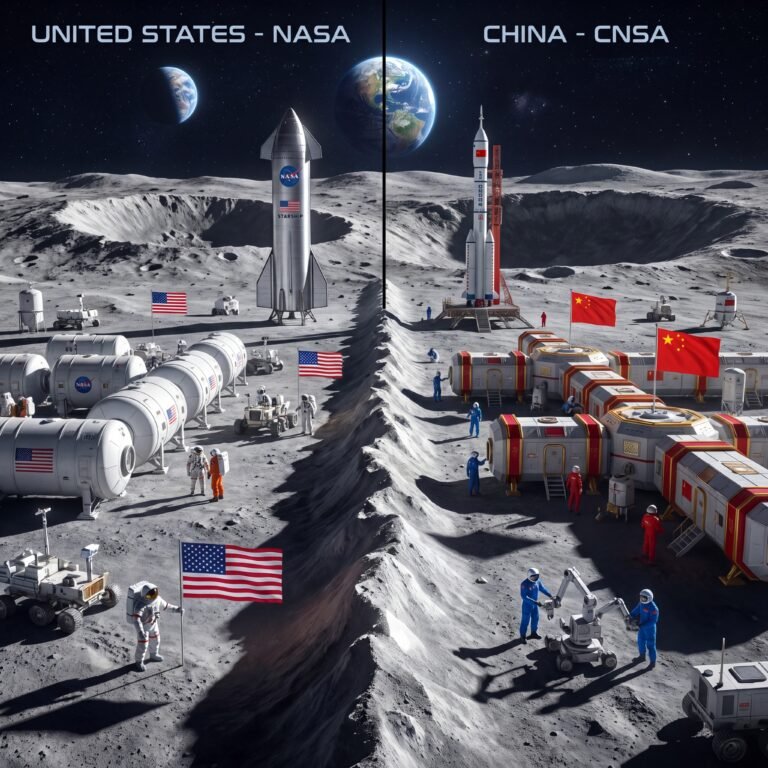
- NASA Artemis III — the first crewed Moon landing since 1972, with Starship serving as the lunar lander
- Point-to-point Earth travel — SpaceX has long proposed using Starship to travel between cities on Earth in under an hour
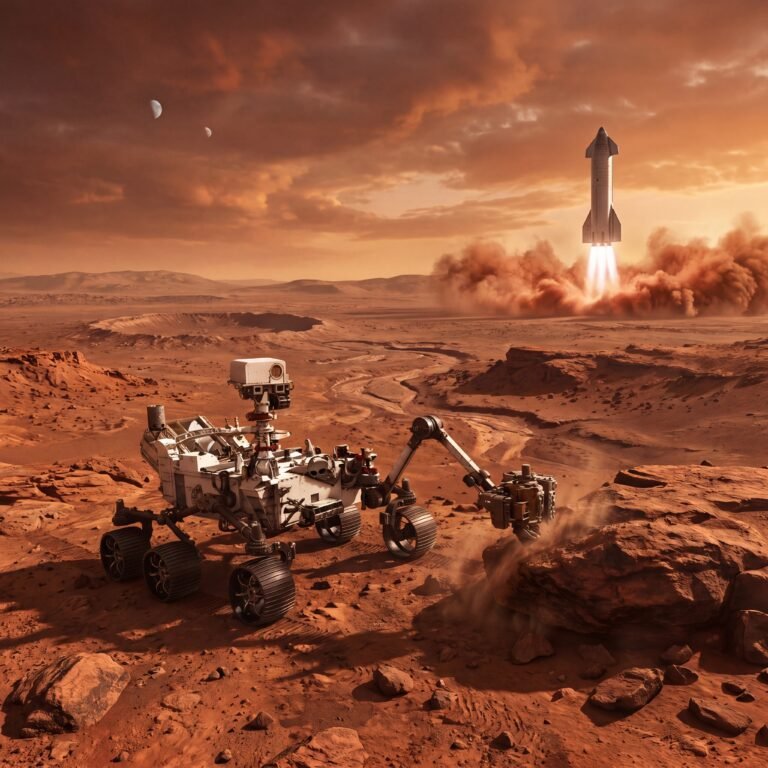
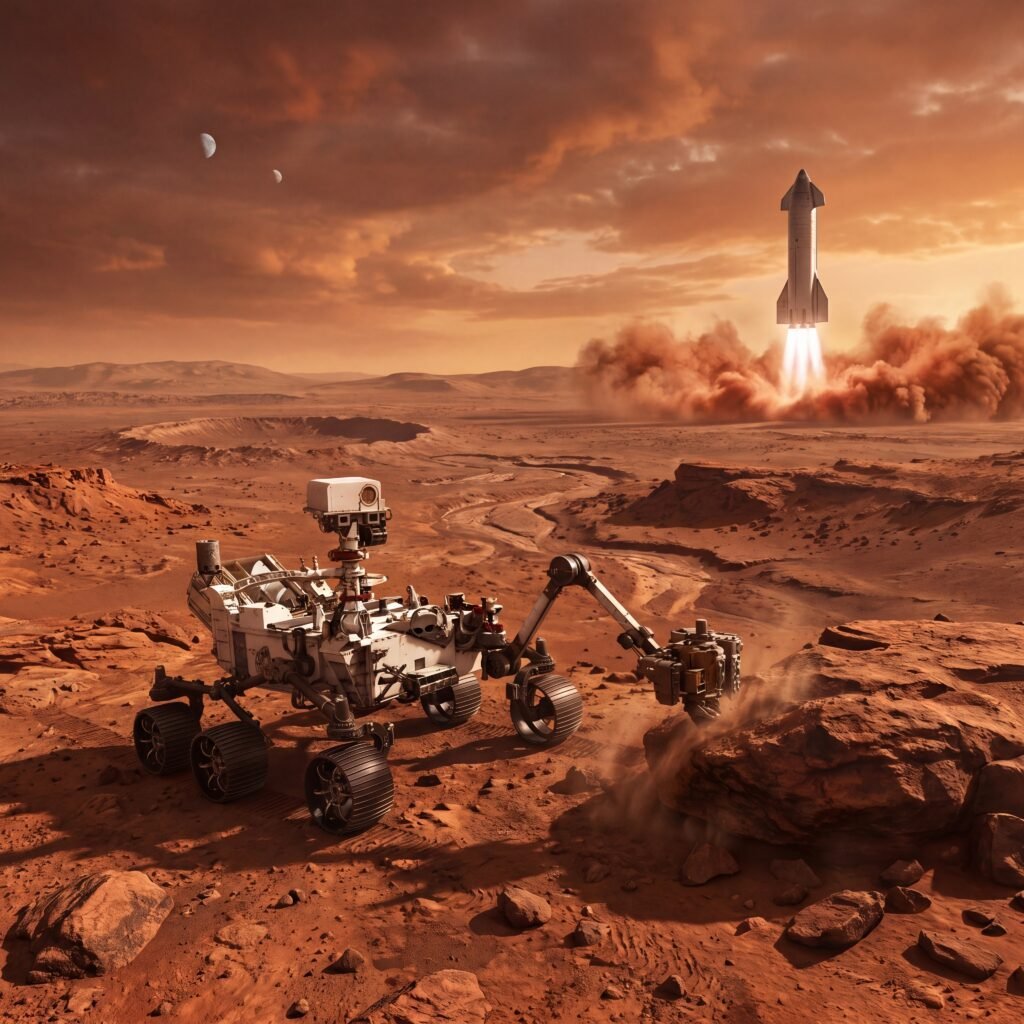
- First Mars cargo missions — uncrewed Starships carrying supplies to Mars ahead of human arrival
- Human Mars missions — the ultimate goal: boots on the red planet
The Bottom Line
Starship V3 represents everything Elon Musk and SpaceX have been building toward for over two decades. It is faster, stronger, simpler, and more reusable than anything that came before it. Flight 12 — with its new engines, redesigned hardware, orbital refueling prep, and heat shield scanning technology — is not just a test flight. It is a statement.
Humanity is serious about leaving the cradle.
Whether Flight 12 launches tomorrow or next week, the outcome is the same: the most powerful rocket ever built is being refined, improved, and made ready for the greatest journeys our species has ever attempted.
Stay watching the skies, because the next chapter of human history is being written right now — and it’s being written in fire and steel, 124 meters at a time.
🌐 Stay updated with neboda.ai — your source for breaking space news, rocket launches, and the future of humanity beyond Earth.